There is a story about the name Liberty Village in Toronto.
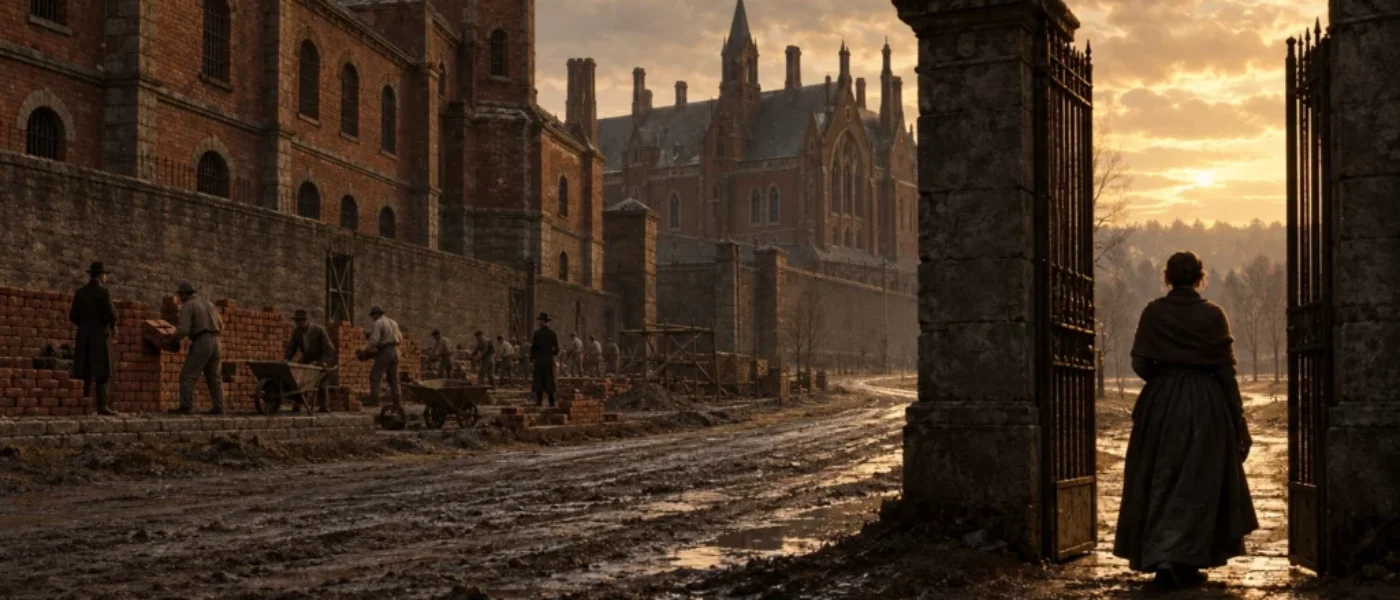
The neighbourhood takes its name from Liberty Street. According to local tradition, that was the street people walked when they left the prisons that once stood nearby. Beyond the walls lay liberty.
It is an appealing image. Someone finishes a sentence, steps into the daylight, and walks towards a life of their own.
Then you look at what happened inside those walls.
The Toronto Central Prison for Men opened in 1873, on land set aside from the provincial asylum farm. Its designers called it an improvement. Men would work, learn trades, and leave better prepared for life outside.
That was the promise. The machinery of the place ran on prison labour.
Men made goods for businesses, worked in shops and a brickyard, and constructed buildings. Their labour was supposed to reform them. It also happened to be very useful to the people in charge.
The prison’s first warden was William Stratton Prince, formerly Toronto’s police chief. He was known as a harsh disciplinarian and struggled with alcohol. Under his watch, brutality became part of prison life. An 1877 inquiry detailed cruelty towards the men held there.
One can only marvel at the confidence behind the appointment. Here was a man entrusted with power over people who could not walk away from him. The system called what followed discipline.
Meanwhile, another man’s name was making its way into the neighbourhood.
Andrew Mercer died in 1871 without a will. Ontario claimed his substantial estate, although others challenged that claim. Governments fought over the right to it. In the end, the province used a large portion of the money to build a new institution bearing his name: the Andrew Mercer Reformatory for Women.
The men imprisoned at Central Prison helped build it.
There is the awful symmetry of the place. Captive men, put to work in the name of their own improvement, raised the walls where women and girls would be confined in the name of theirs.
The reformatory opened in 1880. Its purpose sounded benevolent. Women would be taught respectable habits, useful work, and proper behaviour. But proper depended on who held the power to define it. A woman could be labelled “incorrigible” for conduct that had far more to do with poverty, independence, drinking, or sex than with violence.
Inside, women and girls worked. Some were isolated and abused. Children could be separated from their mothers. Medical treatments could be painful and coercive. In 1948, women imprisoned there protested the mistreatment of a young inmate. The institution remained open.
The men’s prison closed in 1915. The women’s reformatory did not close until 1969.
Nineteen sixty-nine. A year in which human beings had reached the moon, while Toronto was only just closing a place where women could be confined under the language of moral improvement.
The street-name story may be a legend rather than a proven account of how Liberty Street was named. Yet it has lasted because the contrast is impossible to miss. Liberty was what waited outside the gates. Inside, officials had taken the liberty of deciding whose work they could claim, whose behaviour needed fixing, and whose suffering could be described as reform.
The buildings are mostly gone. The name remains.
Walk through Liberty Village now and it is easy to see cafés, offices, and old brick made fashionable again. It takes more effort to picture the men laying those bricks, the women held behind them, and the astonishing certainty of the adults who called the whole arrangement progress.
——-
The Fuckwhittery Footnote
The events in this story are real. The names, dates, and decisions are there for anyone who wants to follow the rabbit hole. There is plenty more to discover.
Most of us did not learn this part of history in a Canadian classroom. We think we should have. Because history is easier to remember when you see the astonishing things people actually decided to do—and the endless human capacity for fuckwhittery.