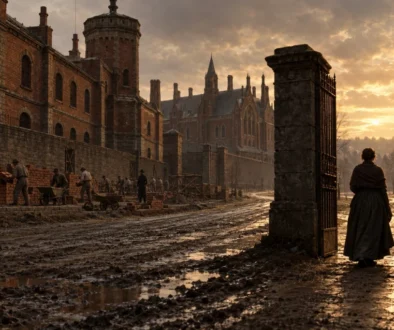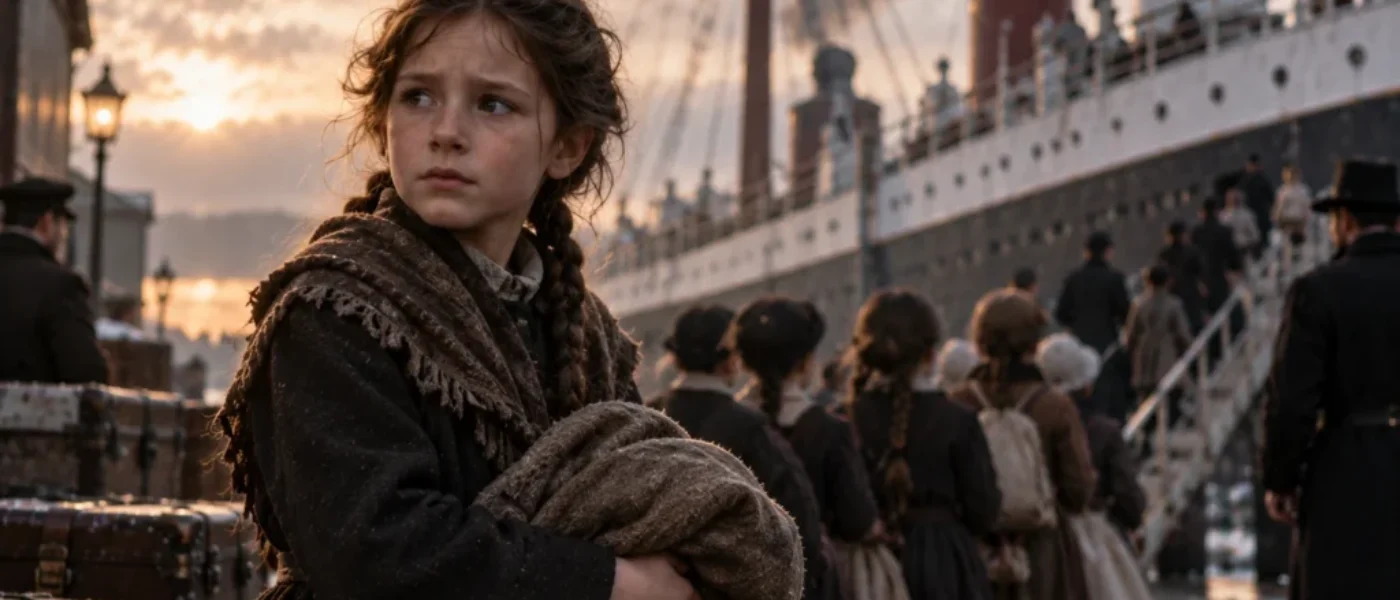
In June 1913, a ten-year-old girl from Sunderland, England, boarded the SS Corinthian bound for Canada. She was travelling with her older sister, 12, and a large group of other children, but she was not an immigrant in the usual sense. Her mother was not standing beside her, preparing to build a new life in a new country. There was no family waiting to establish a home in Canada. Instead, she was being sent across the Atlantic through the Barnardo organization, part of the enormous child migration system that would eventually bring more than 100,000 British children to Canada.
Her journey had begun years earlier with the circumstances of her mother, a working-class woman who had entered domestic service at eighteen. Like thousands of young women of her generation, she earned her living inside other people’s homes, cooking, cleaning, washing and caring for families wealthier than her own. Domestic service offered employment and a measure of respectability, but little independence and almost no financial security.
While still a young woman, she met a musician and married him. She believed herself to be his wife and had two children with him. What she did not know was that the man she had married was already married to someone else. He had lied to her, leaving her unknowingly trapped in a bigamous marriage at a time when the social consequences of illegitimacy fell far more heavily upon women and children than upon the men who created the circumstances.
Later, she met another man and had a daughter with him. They subsequently married and had another daughter, the little girl who would eventually be sent to Canada. For a time, the family appears to have had some stability. Then her husband died while attempting to collect coal from the railway.
His death left her with four children and little means of supporting them. In an age before the modern social safety net, widowhood could push a working-class family from hardship into disaster very quickly. Yet when authorities became involved, the surviving records reveal remarkably little sympathy for the circumstances in which this woman found herself. Instead, an investigator described her as a woman who had “always been dirty, slovenly, and idle in financial difficulties.”
The language matters because it shows how poverty was interpreted. Her financial difficulties were not treated simply as financial difficulties. They became evidence of personal failure. A widowed mother struggling to support four children was described not by what had happened to her, but by what authorities believed was wrong with her. The deception of her first husband, the death of her second husband and the economic vulnerability of a woman raising four children were reduced to a judgment about her character.
That judgment would have consequences far beyond anything written in an official report.
The Children Are Taken
Two of her daughters were taken into the Barnardo system. For a time, the sisters remained together and were fostered by a woman in England who appears to have treated them kindly. Whatever security they found there, however, would not last. The machinery of British child migration was already well established, and Canada had become one of its most important destinations.
https://www.barnardos.org.uk/former-barnardos-children
Beginning in 1869, British charities and child-rescue organizations sent more than 100,000 children to Canada through assisted migration programs. They became known collectively as the British Home Children. Some were orphans, but many had living parents or relatives. Poverty, family breakdown, illness, widowhood and the moral judgments of child-welfare authorities could all contribute to a child entering institutional care. Once inside that system, some children were eventually selected for emigration.
The idea was presented as both rescue and opportunity. British reformers believed poor children could escape overcrowded industrial cities and begin healthier lives in Canada. Canada, meanwhile, had farms and households in need of inexpensive labour. Boys could work on farms, while girls could be placed in domestic service. Humanitarian language and economic usefulness fitted together remarkably well.
In June 1913, the two sisters became part of that movement.
The younger girl was ten years old, her older sister only 12.
Thirteen Days Across the Atlantic
On June 12, 1913, the sisters boarded the SS Corinthian in London. They were not travelling with a handful of Barnardo children. Library and Archives Canada’s passenger records identify their group as a party of 135 girls, travelling with Barnardo Homes and destined for Peterborough, Ontario.
The Corinthian sailed from London on June 12, 1913 and arrived at Quebec on June 25, 1913. The crossing took thirteen days. For almost two weeks, a ten-year-old child lived aboard a steamship carrying her farther from her mother, her home and everything she had known.
This was not a luxury Atlantic crossing, and unusually, we know something about the conditions aboard the Corinthian on this particular voyage.
Less than a month after the ship reached Canada, its conditions were raised in the British House of Commons. On July 21, an MP asked the President of the Board of Trade about complaints from passengers concerning overcrowding, poor bedding and having nowhere to sit during rough weather except their bunks. The government response stated that the Corinthian had been inspected and complied with the requirements of the Merchant Shipping Acts. UK Parliament API
The same answer revealed just how crowded the emigrant side of the ship was. Nine hundred and seventy-nine steerage passengers had boarded at London and Plymouth. Under the official formula used at the time, they were counted as the equivalent of 828 adults.
The government maintained that the space provided exceeded the legal minimum and that dining and recreation rooms were available. That official account should remain part of the record. So should the fact that passengers themselves complained about overcrowding, poor bedding and being confined to their bunks when rough weather made other spaces unusable. UK
Somewhere among those 979 steerage passengers were 135 Barnardo girls.
Two of them were sisters.
One was ten.
We cannot know precisely what she experienced during those thirteen days. There is no reason to invent seasickness, terror or mistreatment that her surviving records do not describe. We do not know what she thought when England disappeared behind the ship or what she understood about the country waiting on the other side of the Atlantic.
What we do know is enough.
Her mother was alive.
She was ten years old.
She was travelling with 134 other Barnardo girls toward a country she had never seen, aboard a ship whose steerage conditions would be questioned in Parliament within weeks of her arrival.
And there was no return ticket.
Peterborough
When the Corinthian reached Quebec on June 25, the ocean crossing was finished, but the children’s journey was not. The Barnardo girls were destined for Peterborough, Ontario, an important centre in the organization’s Canadian placement system.
Barnardo operated Hazelbrae there, later known as the Margaret Cox Home, as a receiving and distribution centre for girls. Children arriving from Britain could be assessed and then placed in Canadian households, with older girls commonly entering domestic service.
The system produced an extraordinary amount of paperwork. Children were received, classified, placed, inspected and sometimes moved. Reports followed them from household to household. Their behaviour could be praised or criticized, their usefulness assessed and their placements reconsidered. On paper, it was an organized system of child welfare. In practice, these were children living thousands of kilometres from anyone who had known them before they entered it.
The ten-year-old girl was moved through a series of Canadian homes. The surviving records offer only fragments of what those years were like, but the fragments are revealing. One placement involved a lock on the door. Another report complained that she was becoming “out of hand.” Such descriptions tell us how the adults responsible for her interpreted her behaviour, but they tell us very little about what the child herself thought was happening.
By then, she had lost her father, been separated from her mother, crossed an ocean and been placed in unfamiliar households where adults controlled almost every important part of her life. Eventually she was also separated from the one person who had travelled through this experience beside her. Her older sister was placed roughly eighty kilometres away.
Today, eighty kilometres is an ordinary drive. For two girls living in early twentieth-century Ontario without independent transportation, money or family support, it created a formidable separation. They had crossed the Atlantic together, only to be divided after they arrived.
Servant
By the time the younger sister appeared in the Canadian census at eighteen, the process that had begun in Sunderland years earlier had reached its logical conclusion. Her occupation was recorded as servant. The child who had entered the Barnardo system after her widowed mother fell into poverty had become a domestic worker in a Canadian household.
The British Home Child system cannot fairly be described as one uniform experience. Some children were treated with genuine affection and eventually considered their Canadian placement families their own. Others endured neglect, isolation, exploitation and abuse. The problem was not that every Canadian family receiving a Home Child was cruel. The deeper problem was the enormous imbalance of power built into the system itself. A child living thousands of kilometres from her family had few practical choices if a placement became unbearable.
Eventually, the girl became a young woman and met another UK immigrant. When they decided to marry, the official registration asked the ordinary questions about their identities and families. There was a place for the name of her mother.
The answer recorded there was:
Unknown.
Two Children, Two Journeys
Exactly four months to the day after the ten-year-old girl arrived in Canada, another 12 year old Welsh child entered through the same Quebec gateway. They were born 300 km from each other – he in Cardiff, Wales and she in Sunderland, UK. His experience of immigration was entirely different. He came with his parents, a cherished child travelling within his family. His parents had chosen to immigrate, and the family eventually settled in Belleville, Ontario.
Years later, the girl sent to Canada through Barnardo’s also found herself in Belleville, still working in domestic service. There she met the boy whose Atlantic crossing had taken place only four months after her own. They had come from the same area (Wales and Southern England) within 300 km of each other and entered Canada through the same port, but one had arrived surrounded by family while the other had arrived because she had been separated from hers.
They married and built a family together.
Their story exposes a part of Canadian immigration history easily lost beneath the familiar account of courageous families crossing oceans in search of opportunity. That story is true, but it was never the only story. Some immigrants chose Canada. Some fled circumstances that left them little choice. Thousands of others arrived as children because governments, charities and institutions had decided that their futures belonged on the other side of the Atlantic.
The British Home Children were not simply unwanted orphans rescued from the streets, although that image remained convenient for generations. Many had families. Their families were often poor, widowed, ill or otherwise unable to satisfy the standards imposed upon them by authorities. Instead of providing enough support to keep some of those families together, institutions could remove the children and eventually send them abroad.
Canada benefited from their labour. Britain reduced the number of poor children requiring support. Charitable organizations could describe the work as rescue, while Canadian households received young workers for farms and homes. The arrangement could therefore appear charitable, practical and respectable at the same time.
That respectability is one of the most troubling parts of the story. No secret organization was required. The ships sailed openly. The children appeared on passenger lists. Governments knew they were coming. Organizations maintained receiving homes and placement records. Canadian families applied for children. Inspectors visited them. Reports were written.
The entire process operated within institutions that believed, or claimed to believe, that they were acting in the children’s interests.
Seen Through Modern Eyes
Read through a modern lens, the British Home Child system bears an uncomfortable resemblance to what we now recognize as human trafficking. The comparison is not exact; this was a different legal and social world. But the similarities are difficult to ignore.
Human trafficking is often associated with sexual exploitation, but it also includes exploitation through labour. Modern Canadian definitions recognize such warning signs as control over where a person lives and works, isolation, financial exploitation, and physical, psychological or sexual abuse. Canada
Now consider what happened to the British Home Children.
Many had living parents. Yet children were removed from vulnerable families, transported across an international border with the cooperation of governments and charitable organizations, and placed in private households where their labour had economic value. Boys commonly worked on farms and girls in domestic service. They had little control over where they lived, whom they worked for or whether they could return home. More than 100,000 children were sent to Canada through these assisted immigration programs, most of them placed with Canadian families. Canada
The danger was not theoretical. Historical accounts document Home Children subjected to harsh labour, physical abuse and sexual abuse. Others found loving homes and later described their Canadian lives positively. This was not one uniform experience, and it would be wrong to describe every receiving family as abusive. What was uniform was the extraordinary imbalance of power: these were children, thousands of kilometres from their families, with very little ability to leave when a placement became exploitative or dangerous.
If someone today took a ten-year-old child whose mother was still alive, transported her to another country, placed her in a stranger’s home to work, controlled where she lived and moved her between households when placements failed, we would ask very different questions about what was being done to that child.
That is what makes this history so unsettling. The acts do not become harmless because the institutions carrying them out called them rescue, migration or placement.
It would be equally wrong to pretend that Barnardo workers, government officials and Canadian families necessarily understood themselves as participating in anything resembling trafficking. Many genuinely believed they were rescuing children from poverty and giving them opportunities.
But good intentions do not erase the structure of a system.
Children were moved across international borders. Families lost control over what happened to them. Their labour had economic value. Some suffered physical and sexual abuse. Their ability to escape an exploitative placement was profoundly limited.
Today, those would be enormous warning signs.
In 1913, they could be paperwork.
And perhaps that is the most disturbing similarity of all. The British Home Child system did not have to operate in the shadows. The ships sailed openly. The children appeared on passenger lists. Receiving homes operated openly. Placements were documented. Inspections were conducted.
The institutions with the power to stop the system were among the institutions that authorized, organized and benefited from it.
And Then They Became Us
More than 100,000 British children eventually came to Canada through these programs. They grew up, married and had children of their own. Their descendants became part of Canadian communities across the country. In many families, however, the details of how a parent or grandparent had arrived in Canada faded into silence. Shame, trauma, secrecy and broken family connections helped bury the story.
Over time, a complicated history could be reduced to a comfortable sentence:
Our family came from England and settled in Ontario.
That sentence was true for these two English children.
It simply concealed two entirely different journeys.
One child crossed the Atlantic with his family.
The other crossed it because she had been separated from hers.
Their paths eventually met in Belleville, where they married and created a family of their own.
But the story does not end in Belleville.
It ends, in part, back in England.
The Mother Who Kept Looking
The Barnardo records preserved by the family contain another part of the story that makes the word “Unknown” almost unbearable.
Their mother had not simply disappeared.
She looked for her daughters.
She had been told that they would write to her after they were sent away. She expected letters. The surviving Barnardo records and correspondence preserved by her descendants show a mother still trying to find the children who had been taken from her.
The letters did not come.
Her daughters were thousands of kilometres away, moving through a Canadian placement system that generated reports about their behaviour, their work and the households in which they lived.
Their mother was still in England trying to find them.
Years passed.
The ten-year-old became a servant, then a young woman. She met an English immigrant in Belleville and prepared to marry him.
On her marriage record, someone asked for her mother’s name.
The answer was:
Unknown.
But her mother was not unknown.
She had entered domestic service at eighteen. She had married a musician who lied to her about already having a wife. She had later found another partner, married him and built another family. Then he died on the railway while trying to collect coal, leaving her with four children and too little money.
Authorities looked at that poverty and described her as dirty, slovenly and idle.
Two of her daughters were taken into care. They were sent across an ocean.
She was told they would write.
And afterward, she went looking for them.
That may be the part of this history most worth remembering.
These children did not arrive in Canada without families simply because the adults they left behind had ceased to exist. They did not become blank pages when their ships sailed from Britain. Behind some of them were mothers and fathers, brothers and sisters, grandparents and neighbours. There were people who knew their names, remembered their faces and wondered where they had gone.
This mother knew exactly who her daughter was.
She had never forgotten her.
And while her daughter was growing up in Canada, the woman officially recorded years later as “Unknown” was still in England trying to find her child.
She had not disappeared.
The system had placed an ocean between them.
The Fuckwhittery Footnote
The events in this story are real. The names, dates, and decisions are there for anyone who wants to follow the rabbit hole. There is plenty more to discover.
Most of us did not learn this part of history in a Canadian classroom. We think we should have. Because history is easier to remember when you see the astonishing things people actually decided to do—and the endless human capacity for fuckwhittery.
Ask ChatGPT: Learn more about the British Home Children in Canada