WHat the Fuck?
Beginning in the 1950s, Newfoundland’s government paid thousands of people to abandon their fishing villages in the name of progress, leaving some families to float their entire houses across the ocean because moving the building was cheaper than replacing it.
WHole Rabbit Hole, Three Sentences
Beginning in 1954, Newfoundland’s government introduced resettlement programmes to move families from isolated fishing villages into larger communities, promising better schools, healthcare, jobs and public services.
By the 1970s, more than 28,000 people had moved and roughly 300 communities had been abandoned, with some families towing their entire houses across the water rather than leaving them behind.
Newfoundland and Labrador still offers financial help for community relocation today, but residents who choose to remain after an approved move can lose essential services, raising the same difficult question about who decides when a community is no longer worth keeping.
Newfoundland’s Floating Houses and the Price of Progress
In October 2026, Netflix released Below, a supernatural thriller set in a remote Newfoundland fishing community. Something strange is lurking beneath the Atlantic, but one of the most remarkable scenes has nothing to do with the fictional monster. A family is towing its entire house across the water, leaving behind a village that has been marked for relocation.
The monster is fiction. The floating house is part of Newfoundland’s history.
For decades, Newfoundland’s government encouraged families to leave small coastal villages and move to larger towns. The goal was to make it easier and cheaper to provide schools, roads, electricity, healthcare and other public services. Officials believed that moving people into larger communities would improve their lives and help build a modern economy.
The policy was called resettlement. Behind that simple government term were thousands of families, abandoned fishing villages and entire houses being hauled across the sea. Generations of history were left behind in communities that the government believed had little future.
All of it was carried out in the name of progress.
The Communities With No Great Future
Newfoundland joined Canada in 1949, bringing hundreds of small fishing settlements into Confederation. Many of these communities, known as outports, were scattered along a rugged coastline and could only be reached by boat. Families had settled in sheltered coves and harbours, where fishing had supported their way of life for generations.
Life in the outports was often difficult. Families relied on fishing, small gardens, hunting, gathering and whatever they could produce or repair themselves. Neighbours helped one another, shared resources and built strong ties through family and community life. These settlements were not wealthy, but they had survived for generations through hard work and cooperation.
Premier Joey Smallwood wanted to change Newfoundland’s economy. His government hoped to attract new industries, create jobs and provide better public services. Smallwood believed that the many small fishing villages made these plans more difficult and expensive.
In October 1957, he suggested that as many as 200 settlements, home to perhaps 50,000 people, might need to be relocated. He described these communities as having “no great future.”
It was a remarkable judgment about places where families had lived, worked and raised children for generations. Their homes, churches, fishing grounds and family histories were suddenly part of a government plan to build a more modern province.
The people who lived in these communities had their own ideas about the future. Some wanted better opportunities elsewhere, while others had no wish to leave the places their families had built.
The government’s solution was to offer money to those willing to move.
The Great Newfoundland Moving Sale
Newfoundland introduced its first provincial centralization programme in 1954. Families living in isolated communities could receive financial assistance if they agreed to move to larger settlements.
The early programme required every household in a community to agree before relocation could take place. Later programmes changed the rules. In 1965, the provincial and federal governments introduced the Fisheries Household Resettlement Programme, which offered more financial support.
Under the 1965 arrangements, an eligible household head could receive $1,000, with another $200 for each member of the household. Some moving expenses could also be covered.
For families with limited savings, this was a considerable amount of money. However, the payment was not always enough to buy or build another home in the community where they were moving.
Newfoundland families faced a difficult choice. They could leave their homes behind and begin again, or they could find a way to take the buildings with them.
Many chose to move the entire house.
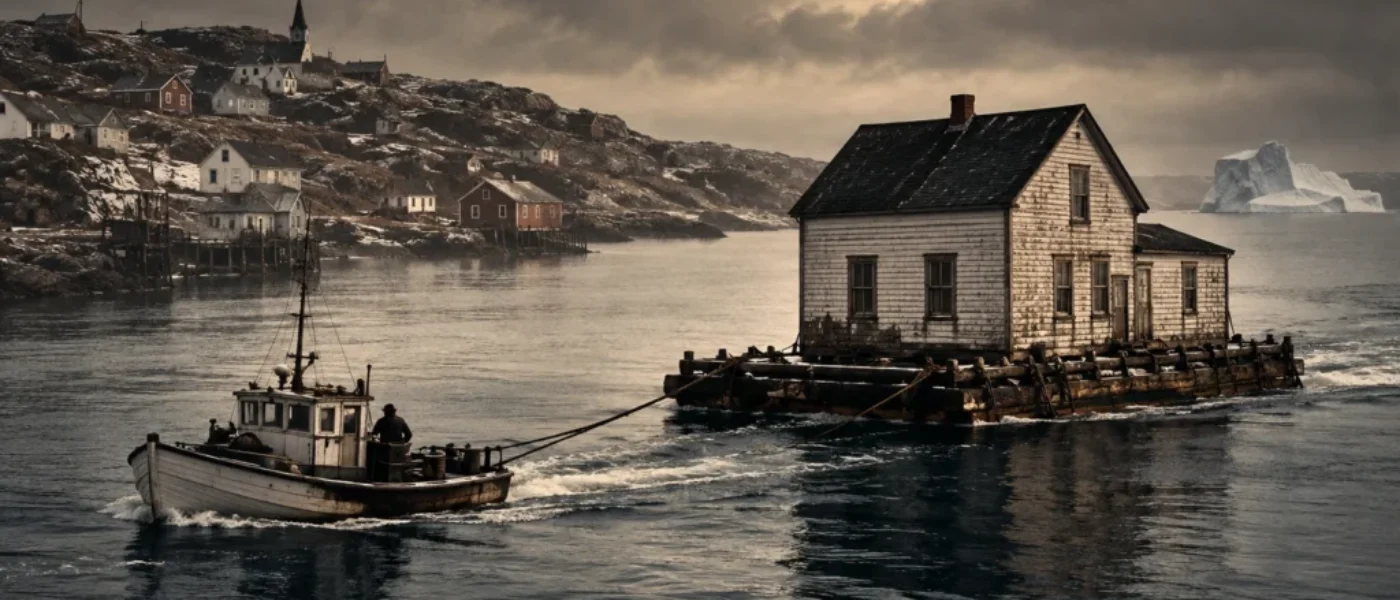
Homes were lifted from their foundations and placed on floating platforms or barges. Boats then towed the buildings across bays, harbours and stretches of open water. Some journeys required special equipment, careful planning and favourable weather.
The sight was extraordinary. A wooden house, complete with windows, doors and sometimes a front porch, could be seen travelling across the Atlantic behind a fishing boat.
In 1965, Mike and Hilda Symmonds had their house floated from North East Crouse to Conche on Newfoundland’s Great Northern Peninsula. Other families moved their houses across Placentia Bay, including buildings taken to Arnold’s Cove.
These journeys were photographed and recorded. Newfoundland’s archives still hold images of houses being transported across the water, sometimes with boats guiding them toward their new locations.
Moving a house was a practical way to save a valuable family possession. It also allowed people to carry something familiar into a new community, even when they could not bring their neighbours, fishing grounds or way of life with them.
When Democracy Becomes a Neighbourhood Argument
The resettlement programmes were officially voluntary, and some families welcomed the chance to move.
Better schools, electricity, medical care, roads and employment were strong reasons to leave an isolated outport. Life in these communities could be demanding, especially during winter storms when travel by boat was dangerous or impossible.
For parents, the chance to give their children a better education or more job opportunities could make relocation an attractive choice.
Other families felt differently. They had spent their lives fishing nearby waters, working their land and living among relatives and neighbours. Moving meant giving up familiar livelihoods and the support of a community they knew.
The decision became even more difficult when entire settlements had to vote on whether to leave.
A family might want to remain, but most of its neighbours might vote to relocate. As people moved away, the local school could lose its students, the shop could lose its customers and the remaining families could find themselves increasingly isolated.
Government policy added further pressure. A shrinking community might no longer receive the same public services, making it difficult for those who wanted to stay.
Although relocation was described as voluntary, the choices were not always simple or equal. A person could refuse to move but still lose the neighbours and services that made remaining possible.
The programmes divided communities. Families argued over whether to accept the payments, and neighbours sometimes disagreed bitterly about the future of their villages.
Some people believed relocation would give their children a better life. Others believed the government was destroying communities that had supported generations of families.
The government expected larger settlements to offer more jobs and a stronger economy. Unfortunately, some of the new industries and employment opportunities failed to appear. Families who had left their homes sometimes found that the promised future was far less secure than they had expected.
Their old communities had already been abandoned, leaving little chance of returning to the lives they had known.
Three Hundred Communities, Gone
By the time the major resettlement programmes ended in the 1970s, more than 28,000 people had moved and roughly 300 communities had been abandoned, according to Memorial University’s Maritime History Archive.
Some villages were emptied completely. Houses were removed or left to decay, wharves fell apart and vegetation slowly covered roads and paths once used by generations of residents.
Schools and churches closed. Fishing stages and sheds disappeared from the shoreline. In some places, only cemeteries remained, holding the graves of families whose descendants now lived elsewhere.
The results were mixed. Historical research shows that many families were satisfied with their decision to relocate, especially when their children gained access to better schools and services.
Others suffered serious losses. Moving could mean giving up fishing grounds, jobs, family networks and the support of neighbours. A government payment could help cover the cost of moving, but it could not replace a community’s history or the relationships built over generations.
One of the most remarkable surviving examples is the Drake House in Arnold’s Cove.
The house was built in Haystack during the 1890s and later belonged to Frank Drake. When the community was resettled in the 1960s, Drake refused to leave. He remained for another twelve years before his house was eventually floated to Arnold’s Cove in the 1970s.
The building survives as a historic structure and museum, preserving part of the story of Newfoundland’s resettlement years.
The Drake House was saved and given a new location. Haystack, the community where it had stood for generations, was abandoned.
The Scheme That Refused to Die
Newfoundland’s large government-led resettlement programmes ended decades ago, but community relocation remains part of provincial policy.
Newfoundland and Labrador still has a Community Relocation Policy. Unlike the earlier programmes, the modern process begins when a community requests assistance rather than when the government selects settlements for relocation.
Under the policy, at least 75 per cent of voting-aged permanent residents must support relocation before it can proceed.
Eligible homeowners can receive between $250,000 and $270,000 per household, depending on household size. Eligible adult permanent residents who do not own a home can receive $10,000.
The government also considers the cost of continuing to provide services. A relocation proposal is generally expected to produce public savings of about $10 million over twenty years.
The calculation is straightforward from a government budget. Providing ferries, roads, electricity, schools and healthcare to a small, isolated community can be extremely expensive. Moving residents to larger towns may reduce those costs.
For the people who live there, the decision is far more personal.
Residents who oppose an approved relocation are not legally required to leave their homes. They can choose to remain in the community.
However, once relocation takes place, provincial and municipal services are withdrawn. Depending on the community, this can include electricity, ferry connections, road maintenance, garbage collection, schools and healthcare services.
A resident may still own a house and have the legal right to stay, but living there without essential services can become extremely difficult.
The modern policy gives communities a formal role in requesting relocation and voting on their future. It also shows how the cost of public services continues to influence decisions about whether small coastal settlements can survive.
For families whose roots reach back generations, the value of a community cannot be measured only by the amount of money required to maintain it.
The Monster Beneath the Water
Netflix’s Below, released in October 2026, places this history inside a supernatural story.
The fictional Newfoundland community of Snook’s Arm faces a relocation vote as its residents struggle with the decline of traditional fishing livelihoods. The series adds melting ice, a mysterious marine creature and the threat of something ancient emerging from the Atlantic.
The monster belongs to fiction, but the struggle over the community’s future comes from a very real part of Newfoundland’s history.
For generations, coastal settlements have faced economic hardship, changing industries and uncertain futures. The collapse of the northern cod fishery and the 1992 fishing moratorium brought further hardship to communities that had long depended on the sea.
Climate change now adds another concern for places already dealing with declining populations, rising costs and limited employment.
The cost of maintaining remote communities is a genuine problem. Roads, schools, ferries, healthcare and electricity require money, workers and equipment. Providing these services to a small population spread across a difficult coastline is not easy.
Yet a community is more than the cost of its public services.
It is the place where children grow up, where families earn their living and where generations have built their homes. Its history lives in the people, buildings, fishing grounds, cemeteries and traditions that connect one generation to the next.
When governments decide that relocation is the best solution, the financial savings can be calculated. The loss of a community is much harder to measure.
The floating houses of Newfoundland remain one of the most striking images of that history. Families found a way to carry their homes across the water, saving the buildings even as the villages around them disappeared.
The government called it resettlement. The photographs show houses floating across the Atlantic, carrying pieces of communities that would never exist in quite the same way again.
Progress had a price. For thousands of Newfoundland families, that price included the places they called home.
Psst… WHere We’ve Seen This Before
Newfoundland’s resettlement programmes were not the only time Canadian governments decided that progress was worth the loss of a community.
In The Villages We Put Underwater, entire communities lost their homes, farms, churches and history to reservoirs built for hydroelectric power. The promise of a brighter future came at a cost paid by the people forced to leave.
In The Water, the Schools, and Everything Else We Don’t Talk About, we examine the far more serious harm caused when governments controlled Indigenous communities without respecting their rights or wishes.
These events were different, and the injustices were not equal. Yet they reveal a familiar pattern: governments make decisions in the name of progress, while other people bear the cost.
Progress is easier to celebrate when it is not your home, community or history being lost.
Keep Following the WHole Rabbit Hole
Two more Canadian stories show what happens when governments decide that communities must make way for progress.
The FuckWHittery Footnote
The events in this story are real. Newfoundland’s resettlement programmes, government payments, abandoned communities and entire houses floated across the water are documented in historical records. Community relocation also remains part of provincial policy today.
Most of us did not learn that hundreds of Newfoundland communities disappeared in the name of progress. Even fewer learned that some families took their houses with them. These stories deserve a place in Canadian history lessons.
There is something revealing about a government calculating the cost of keeping a community alive while its residents face the cost of losing their homes, neighbours and history.
The sea monster in Below may be fictional. The extraordinary human capacity for fuckwhittery is not.
Still Wondering WHat the Fuck?
Explore why Newfoundland’s government encouraged people to leave small coastal communities, how families moved entire houses across the water, and what happened to the places they left behind. Follow the original records and learn how community relocation still works today.
Take This Rabbit Hole to ChatGPT →The WHole Paper Trail
These archives, historical studies and government records document the resettlement programmes, the houses moved by water and the rules that still apply to community relocation today.
Memorial University — “No Great Future”: Government-Sponsored Resettlement →
Archival records, government history and photographs documenting the resettlement programmes and the communities affected.
Heritage Newfoundland — The Resettlement Program →
Explains the government payments, resettlement rules and the remarkable practice of moving houses across the water.
Heritage NL — Resettlement Under the Smallwood Administration →
Examines Joey Smallwood’s policies, the scale of resettlement and the effects on Newfoundland communities.
Newfoundland and Labrador Government — Community Relocation Policy FAQ →
The provincial government’s explanation of current relocation rules, voting requirements, payments and public services.
Maritime History Archive — Mike and Hilda Symmonds’ Floating House (1965) →
An archival photograph documenting a house being moved by water during resettlement.
Heritage Newfoundland — Drake House, Arnold’s Cove →
The history of Frank Drake’s home, preserved after its move to Arnold’s Cove.