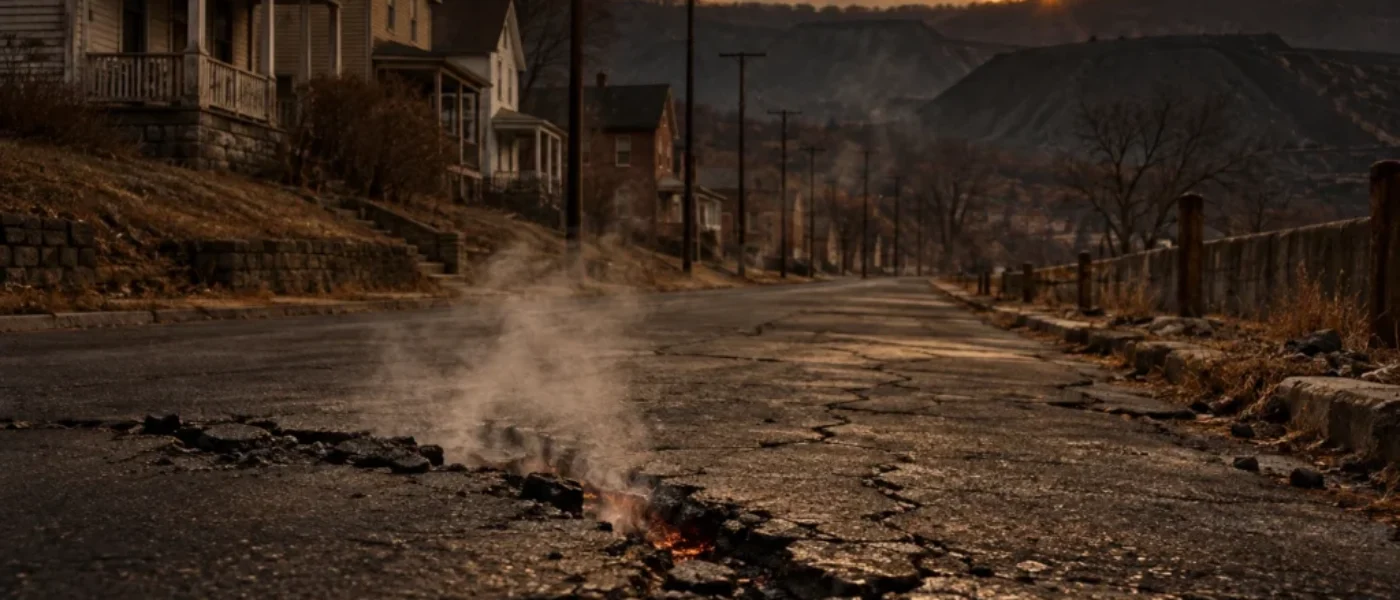
I was watching the 2006 horror film Silent Hill when the burning town began to seem a little overdone.
Smoke rising from the streets. Fire somewhere deep beneath the houses. Ground that might open without warning. Surely that was the part the filmmakers had invented.
Then I discovered Centralia, Pennsylvania.
Its underground coal fire began in 1962. I was born in 1968. That fire had already been burning for six years before I was alive.
It is still burning right now, as I write this.
The monsters in Silent Hill were fiction. The filmmakers borrowed the burning ground from Centralia.
The story begins with rubbish.
Centralia was a mining town built above coal and old mine workings. At its edge, an abandoned surface mine pit had been turned into a dump. As Memorial Day 1962 approached, the borough council arranged to have the dump cleaned up.
The fire reportedly began when rubbish in the pit was deliberately burned.
That is where I want to pull out a chair at the council table.
I want to see the map they were looking at. I want to know whether someone pointed out that their town sat on coal, that the dump occupied an old mine pit, and that fire has a well-established interest in both of those things.
I want to know what answer could possibly have made everyone comfortable enough to carry on.
The surviving account does not give me a tidy scene in which one person proposes the burn and every other person enthusiastically agrees. What it does give me is a council-arranged cleanup, a rubbish fire in an old mine pit, and a fire that reached the coal below.
The pit lacked a proper barrier to stop it spreading. Once underground, the flames could move through old mine workings beyond anyone’s easy reach.
Consider the distance between the intention and the result.
A municipal cleanup. A town lost.
For years, officials tried to control the fire. Smoke and dangerous gases rose through the ground. Streets could sink as the workings beneath them failed. By 1983, a government study estimated that extinguishing the fire would cost $663 million. Money was set aside to relocate people instead. Homes and businesses were acquired; hundreds of buildings were demolished. Even a highway had to close.
All of this followed an effort to make the dump look better.
The people of Centralia had to surrender their homes to a fire they had never asked for. Their streets disappeared above ground while the cause kept travelling below it.
And that is the element no horror film could improve: the calm, practical air a terrible idea can wear when adults discuss it around a table.
Somebody saw a rubbish-filled mine pit in a coal town and decided fire belonged in the solution. The cleanup lasted a day. Its aftermath has lasted longer than my life.
And it is still burning right now.
——-
The Fuckwhittery Footnote
The events in this story are real. The names, dates, and decisions are there for anyone who wants to follow the rabbit hole. There is plenty more to discover.
Most of us did not learn this part of history in a classroom. We think we should have. Because history is easier to remember when you see the astonishing things people actually decided to do—and the endless human capacity for fuckwhittery.
Explore Centralia’s underground fire in ChatGPT