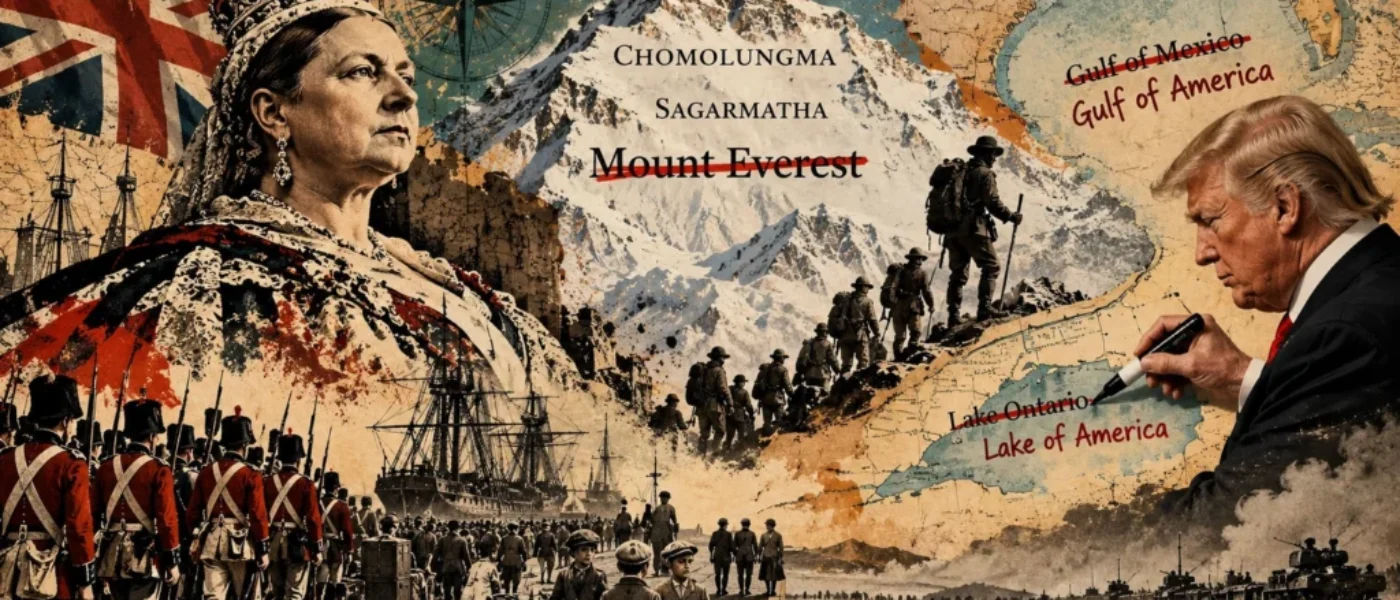
WHat the Fuck?
The British Empire may have collapsed, but its centuries-old methods of claiming territory, moving populations, rewriting maps and manufacturing reasons for military intervention are still being used by the world’s powerful nations.
WHole Rabbit Hole, Three Sentences
For centuries, Britain built an empire by exploiting poverty, transporting unwanted populations, rewarding privileged families with military authority and claiming lands already occupied by other people. The United States, Russia and other modern powers have used variations of these methods, often presenting expansion as protection, national security or the defence of their own citizens. From renaming Chomolungma to Mount Everest to Donald Trump’s attempts to rename the Gulf of Mexico and Lake Ontario, the language of empire has changed far less than we might like to believe.
A Lake, a Mountain, and an Old Imperial Habit
In January 2025, Donald Trump directed the United States government to rename the Gulf of Mexico as the Gulf of America. The announcement provoked international criticism and considerable public outrage, particularly in Mexico, where the name had been established for centuries. The decision did not alter international boundaries or give the United States any additional authority over the waters, but it demonstrated how easily a geographical name could become a political controversy.
The episode reminded me of something I had recently learned while watching a film “Tenzing (2026)” about Tenzing Norgay, the Sherpa mountaineer who reached the summit of the world’s highest mountain with Edmund Hillary in 1953. Like most people raised in the English-speaking world, I had always known the mountain as Everest, without considering that the people who lived in the Himalayas had known it by other names for generations.
Tibetan communities knew the mountain as Chomolungma, a name associated with a divine mother. In Nepal, it is known as Sagarmatha. In 1865, British geographical authorities officially named it Mount Everest in honour of Sir George Everest, a former Surveyor General of India who had never climbed the mountain and was not responsible for establishing its height.
British surveyors had measured the mountain and recorded its position, but the decision to attach the name of a British official reflected something larger than geographical convention. Throughout the centuries of European imperial expansion, the authority to name places became closely associated with the authority to claim, administer and describe them.
The mountain had existed long before British surveyors arrived, and the communities living around it had their own knowledge of its geography and significance. Nevertheless, the name selected by British officials became the one reproduced on maps, in atlases and eventually in classrooms throughout much of the world.
The Machinery of the British Empire
At its height, the British Empire controlled approximately one-quarter of the world’s land and population, with territories stretching across North America, the Caribbean, Africa, India, Asia and the Pacific. Its expansion depended on military power, commercial interests, colonial settlement and political arrangements that frequently placed distant populations under British authority.
The empire also benefited from social structures that had existed within Britain for centuries. Among landowning families, inheritance customs generally favoured the eldest son, who received the principal family estate. Younger sons were expected to establish careers elsewhere, often entering the military, clergy, law or colonial administration.
Military commissions could frequently be purchased until reforms in 1871, allowing wealthy families to secure positions of authority for their sons. Poorer men, meanwhile, were drawn into military service by limited employment opportunities and the promise of regular wages, food and accommodation. The system provided the empire with officers drawn disproportionately from privileged families and ordinary soldiers recruited largely from working-class communities.
Britain also used its overseas territories as destinations for populations that its domestic institutions struggled to accommodate. Beginning in 1788, approximately 162,000 convicted prisoners were transported to Australia, where their labour contributed to the establishment and expansion of colonial settlements. During the nineteenth and early twentieth centuries, more than 100,000 disadvantaged British children were sent to Canada through organized migration schemes, often to work on farms or in private households.
Other migrants included impoverished families, religious communities and people seeking opportunities unavailable to them in Britain. Their experiences varied considerably, ranging from successful new beginnings to exploitation, hardship and abuse. Collectively, these movements strengthened Britain’s overseas settlements while increasing pressure on the Indigenous populations whose lands were being occupied.
The empire had developed a system in which inherited wealth, economic inequality, population movement and military service contributed to territorial expansion. These arrangements were not always directed by a single policy, but their combined effect helped Britain establish and maintain political authority across enormous distances.
First the Settlers, Then the Soldiers
Colonial settlement frequently created the conditions for further imperial intervention. As British communities, businesses and investments became established overseas, the government acquired additional reasons to extend its political and military influence. The protection of British subjects, commercial interests and strategic territories became recurring justifications for intervention.
During the nineteenth century, British officials became increasingly concerned about Russian expansion through Central Asia and the possibility that Russian influence might threaten India. Afghanistan occupied a strategically important position between the two empires, making its political independence a matter of considerable interest to governments in London and St. Petersburg.
Britain invaded Afghanistan in 1839 and installed a ruler considered more favourable to British interests. The occupation encountered fierce resistance and ended in the disastrous British retreat from Kabul in 1842. Another invasion followed in 1878, again driven largely by concerns about Russian influence and the security of British India.
These campaigns formed part of the Great Game, the prolonged rivalry between Britain and Russia for influence in Central Asia. British officials presented their actions as necessary for imperial security, while Afghan communities experienced foreign military intervention intended to shape their country’s political future.
Similar arguments have appeared in more recent history. Russia has repeatedly invoked the protection of ethnic Russians and Russian-speaking communities beyond its borders as justification for political and military intervention. These claims became prominent during the annexation of Crimea in 2014 and the full-scale invasion of Ukraine in 2022, when Russian officials alleged that Russian-speaking populations faced persecution requiring military protection.
Russian imperial and Soviet history differs considerably from Britain’s colonial experience, but both provide examples of governments using security concerns and relationships with populations beyond their borders to justify intervention. The presence of settlers, commercial interests or culturally connected communities can become part of an argument for extending political authority into neighbouring territories.
America Inherited More Than the English Language
The American Revolution is generally remembered as a struggle against British imperial authority. In 1776, thirteen colonies declared independence, rejecting taxation without representation and the political control exercised by the British Crown and Parliament. The revolution established a republic founded upon principles of liberty, representative government and individual rights.
The colonists had nevertheless inherited British legal traditions, property systems and assumptions about European settlement. Many had opposed British restrictions on westward expansion following the Royal Proclamation of 1763, which attempted to limit settlement beyond the Appalachian Mountains and reduce conflict with Indigenous nations.
Following independence, the United States expanded rapidly across North America. The Louisiana Purchase of 1803 transferred French territorial claims to the American government without the consent of the Indigenous peoples already occupying those lands. Further expansion followed through purchases, treaties, annexations and military conquest, frequently accompanied by the displacement of Indigenous communities and the violation of existing agreements.
During the nineteenth and twentieth centuries, American influence extended beyond the continent through territorial acquisitions, military intervention and commercial relationships in the Caribbean, Pacific and Latin America. Although the United States developed its own political institutions and imperial ambitions, many of its methods had recognizable precedents in European colonial expansion.
The American Revolution had ended British political authority over the thirteen colonies, but independence did not immediately remove the assumptions about territorial ownership and expansion that had developed within British colonial society. The new republic inherited a political culture shaped by European settlement and subsequently developed its own approaches to acquiring and governing territory.
The Empire Disappeared. Its Influence Did Not.
The decline of the British Empire unfolded throughout the twentieth century as independence movements challenged colonial rule and two world wars weakened Britain’s economic and military position. India and Pakistan achieved independence in 1947, followed by numerous African and Caribbean nations during the decades that followed.
By the time Queen Elizabeth II died in September 2022, the empire she had inherited as a young monarch had largely disappeared. The Commonwealth remained as a voluntary association of independent countries, some retaining the British monarch as head of state while others had established republics.
The institutions and ideas developed during centuries of British expansion proved considerably more enduring. Canada retained its parliamentary traditions, constitutional monarchy and much of its legal framework, while colonial boundaries continued to define countries across Africa, Asia and the Americas. English remained a dominant international language, and British geographical names survived on maps throughout the world.
Generations of children learned about European explorers, territorial acquisitions and the development of modern nations through educational systems shaped by those same colonial institutions. Indigenous peoples were frequently presented as participants in European history rather than as nations possessing their own histories, governments and relationships with the land.
The familiar accounts of exploration and settlement often gave limited attention to the people whose territories had been claimed or whose political independence had been displaced. The historical evidence was not necessarily concealed, but the version presented in classrooms generally reflected the institutions and perspectives of the societies that produced it.
Recognizing the Pattern
The growing accessibility of historical information has made it possible to examine these events from perspectives that were previously difficult for ordinary readers to encounter. Digitized archives, historical maps, government records and Indigenous scholarship provide opportunities to compare established accounts with the experiences of communities affected by colonial expansion.
This wider access also allows events separated by centuries to be examined alongside one another. British imperial expansion, Russian territorial claims and American continental expansion developed under different political systems and historical circumstances, yet each offers examples of governments using security, settlement, economic interests or historical relationships to justify extending their authority.
The renaming of geographical features belongs to a related tradition in which political institutions assert authority through official recognition. The British decision to name Chomolungma after George Everest and the American decision to rename the Gulf of Mexico arose under very different circumstances, but both illustrate the ability of governments to establish names that reflect their own priorities.
Modern political controversies can become particularly absorbing when they involve national identity, sovereignty or historical ownership. Arguments about geographical names attract considerable attention, even when the legal consequences of a decision are limited. Such disputes can occupy public debate while more complicated questions about economic policy, military spending and government accountability receive less scrutiny.
Whether a particular controversy was deliberately created as a distraction requires evidence. The broader history, however, demonstrates how frequently governments have relied upon national pride, security concerns and territorial symbolism to justify their decisions.
Beyond the World We Inherited
Growing up in Canada meant growing up within institutions, traditions and historical accounts inherited largely from Britain. The familiar boundaries, geographical names and systems of government appeared to be permanent features of the world, while their origins were generally explained through dates, treaties and the achievements of prominent historical figures.
A closer examination reveals how many of these arrangements emerged from decisions made within particular systems of wealth, power and political ambition. Borders were established through negotiations and conflicts, territories were acquired through purchases and treaties, and populations were moved or displaced as governments pursued their economic and strategic interests.
These decisions shaped the world inherited by generations who had no part in making them. Their consequences remain visible in political institutions, international relationships and disputes over land, identity and sovereignty.
Recognizing those origins provides a different perspective on contemporary events. Governments continue to invoke national security, historical entitlement, economic necessity and the protection of selected populations when explaining their actions beyond established borders. Each situation requires examination on its own evidence, but the historical precedents offer useful grounds for questioning the explanations being presented.
The British Empire has disappeared as a system of colonial government, and its former territories have developed independent identities and political ambitions. Many of the assumptions associated with imperial power, however, continue to influence international affairs.
The value of historical knowledge lies partly in its ability to reveal these continuities. Access to records, competing accounts and perspectives once excluded from conventional histories allows people to examine the institutions they inherited and recognize the circumstances in which those institutions were created.
Chomolungma stood for millions of years before British surveyors recorded it as Mount Everest. The Gulf of Mexico had an established name long before an American president decided that federal agencies should use another.
The authority to place a name on a map has never been the same as the authority to define the history of the people and places represented upon it. Understanding that distinction offers a useful starting point for examining the world beyond the colonial assumptions through which so many of us first learned to see it.
The Empire Died. Nobody Told the Playbook.
The British Empire has largely disappeared, yet its influence survives in the borders, institutions and geographical names inherited by countries around the world. Its expansion depended on military power, colonial settlement and political arrangements that often placed distant populations under British authority.
From the renaming of Chomolungma to Mount Everest to modern disputes over territorial claims, the history of empire offers a way to examine how governments use names, security and national identity to assert power. The circumstances differ, but the historical precedents deserve attention.
Keep Following the WHole Rabbit Hole
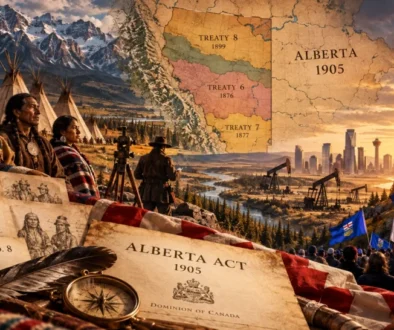
The imperial habit of claiming land already occupied by others appears throughout Canadian history. These earlier stories follow the borders, purchases and decisions that helped shape the country.
The FuckWHittery Footnote
The British Empire did not invent conquest, forced migration or territorial expansion. Its institutions and practices nevertheless influenced much of the modern world, from colonial borders and legal systems to the names that appeared on official maps.
The historical record allows us to examine these connections through military campaigns, migration policies, government documents and the experiences of people who lived with their consequences. Similarities between events do not make them identical, but they provide useful grounds for questioning familiar claims about protection, security and national interest.
History becomes more revealing when we examine who held the authority to make these decisions and whose lives were changed by them.
Still Wondering WHat the Fuck?
Follow the history behind the imperial playbook: British inheritance and military privilege, convict transportation, the migration of children to Canada, the naming of Chomolungma, the Anglo-Afghan Wars and the territorial ambitions of modern powers. Explore the documents and distinguish historical evidence from comparisons across centuries.
Take This Rabbit Hole to ChatGPT →The WHole Paper Trail
The history behind these comparisons is recorded in archives, institutional collections and scholarly reference works. These sources offer starting points for exploring how imperial expansion shaped settlement, geographical naming and military intervention.
Royal Geographical Society — Everest and the Naming of the Mountain →
The society’s historical collections provide context for British surveying and the adoption of the name Everest.
Australian National Museum — Convict Transportation →
Background on the transportation of British convicts to Australia and the establishment of penal colonies.
Library and Archives Canada — British Home Children →
Records and historical background on children sent from Britain to Canada through migration schemes.
Encyclopaedia Britannica — British Empire →
An overview of the empire’s expansion, institutions and eventual decolonization.
Encyclopaedia Britannica — First Anglo-Afghan War →
The British invasion of Afghanistan, the installation of a ruler and the retreat from Kabul.