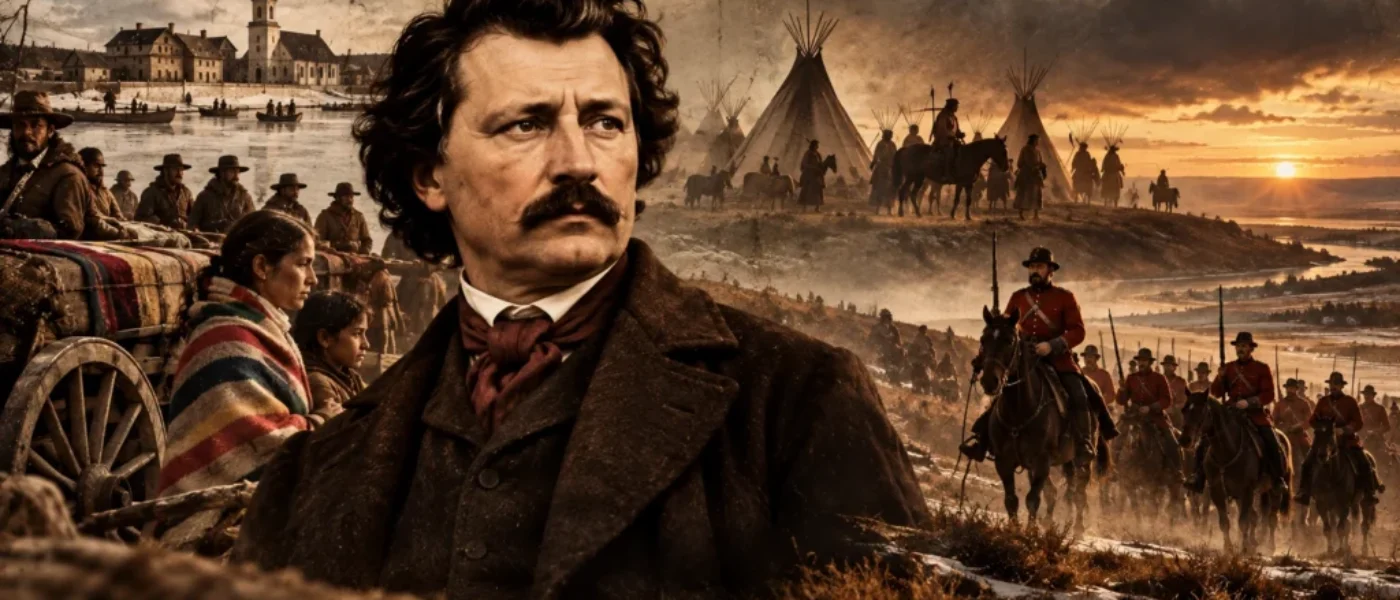
WHat the Fuck?
In 1869, Canada arranged to acquire an enormous stretch of western territory from a fur-trading company without securing the agreement of the people living there, and Louis Riel had the audacity to suggest that their rights might actually matter.
WHole Rabbit Hole, Three Sentences
In 1869, Canada negotiated the transfer of Rupert’s Land from the Hudson’s Bay Company without securing the agreement of the Métis and First Nations already living across the territory. Louis Riel led the Red River Resistance, helping negotiate the creation of Manitoba in 1870 and promises of land and rights that Canada would struggle—and often fail—to honour. By the time Alberta and Saskatchewan appeared on the map in 1905, the treaties, broken promises, resistance and dispossession behind those tidy provincial borders had already shaped generations of lives.
In 1869, the Canadian government was preparing to acquire an enormous portion of western North America from the Hudson’s Bay Company. The arrangement had been negotiated in London, the company was to receive £300,000, and the young Dominion of Canada was imagining a magnificent future stretching across the continent.
There was just one rather extraordinary problem.
Nobody had secured the agreement of the people already living there.
Not the Métis families who had farmed along the Red and Assiniboine rivers for generations. Not the First Nations whose territories extended across the plains, forests and waterways. Not the communities whose homes, livelihoods and political relationships were about to be placed under the authority of a government thousands of kilometres away.
Canada had negotiated with Britain and a fur-trading company as though the people who actually lived on the land were an administrative detail.
Then a young Métis leader named Louis Riel decided that perhaps somebody ought to ask them.
Imagine somebody arriving at your family farm, announcing that the property was about to become part of a new country, and beginning to measure it into different parcels before discussing whether you had any rights to the place.
That was the atmosphere in which resistance began.
The People Who Were Apparently Inconvenient
The Red River Settlement, near present-day Winnipeg, was not an empty wilderness waiting for civilization to arrive.
It was home to a substantial Métis population with its own language, culture, political traditions and established system of river-lot farming. Families lived on long, narrow properties extending back from the waterways, an arrangement that provided access to transportation, water and agricultural land.
The community had developed through generations of relationships among First Nations peoples and European fur traders. Its economy included farming, fishing, hunting, trade and the buffalo hunt, which was central to many Métis families’ livelihoods.
These were not temporary occupants waiting for Ottawa to assign them a purpose.
They had homes, churches, farms, businesses and an established society.
Nevertheless, when Canada arranged to take control of Rupert’s Land, it proceeded without negotiating the terms of government with the people of Red River.
Even before the transfer was completed, Canadian surveyors arrived to divide the land into rectangular townships, following a system entirely different from the existing river lots.
Louis Riel Wasn’t Interested in Being Erased
Louis Riel was just twenty-five years old when he emerged as a leader of the Red River Resistance in 1869. He was educated, politically astute and well aware of what could happen to the Métis communities along the Red River if Canada simply took possession of the territory without consulting the people who lived there.
The Hudson’s Bay Company had agreed to transfer Rupert’s Land to Canada, but nobody had bothered to negotiate with the Métis about what that meant for their homes, farms, language, religious institutions or political representation. Families had occupied and cultivated land along the river for generations, with established communities and their own systems of landholding. Now Canadian surveyors were arriving to divide up territory according to a system that took little account of what was already there.
In October 1869, Métis residents confronted surveyors working near St. Vital and stopped them from continuing. Shortly afterward, Riel and his supporters prevented William McDougall, Canada’s appointed lieutenant-governor, from entering the settlement. They occupied Upper Fort Garry and established a provisional government to negotiate the terms under which Red River would become part of Canada.
Riel was not necessarily opposed to Confederation. What he and other representatives wanted was some assurance that joining Canada would not mean surrendering everything their communities had built. They demanded recognition of existing landholdings, representative government, protections for French and English language rights, and guarantees for their religious and cultural institutions.
These were hardly extraordinary demands. They were the kinds of protections any established community might reasonably expect before being absorbed into a country whose government had already demonstrated a remarkable willingness to make decisions about them without their participation.
The situation, however, was far from peaceful. Red River was divided, and Riel’s provisional government faced opposition from settlers and Canadian expansionists who rejected its authority. Tensions escalated through the winter, culminating in the execution of Thomas Scott in March 1870. Scott, an English-speaking opponent of the provisional government, had been imprisoned following resistance to Riel’s leadership. His execution provoked outrage, particularly in Ontario, and would haunt Riel’s political career for the rest of his life.
It is an uncomfortable part of the story, and one that doesn’t disappear simply because Riel’s broader cause was justified. He was a complicated political figure operating in an increasingly volatile situation, not the flawless national hero or irredeemable villain that competing versions of Canadian history would later make him.
What matters is that the people of Red River had challenged Canada’s assumption that acquiring territory from the Hudson’s Bay Company automatically gave Ottawa the right to determine the future of everyone living there. Their resistance brought the Canadian government to the negotiating table and helped produce the Manitoba Act of 1870.
Of course, negotiating promises and actually keeping them would turn out to be two very different things.

Manitoba Was Born From a Negotiation Canada Had Tried to Avoid
In May 1870, Parliament passed the Manitoba Act, establishing Canada’s fifth province and bringing the Red River Settlement into Confederation under terms negotiated with representatives of the provisional government.
The legislation incorporated several of the protections sought during the Red River Resistance, including provincial representation, recognition of English and French language rights, protections for denominational schools and provisions addressing existing landholdings. For the Métis, whose families had established communities along the Red River generations before Canada acquired the territory, these guarantees were essential to preserving their place in the new province.
One of the most significant provisions was Section 31, which set aside 1.4 million acres of land for the benefit of the children of Métis families. The intention was to provide a foundation for future generations as immigration and settlement transformed Manitoba. Rather than simply recognizing the land already occupied by Métis families, the legislation promised their children a substantial share of the territory that would become the new province.
Implementing that promise proved considerably more complicated than passing the legislation.
The distribution of land was delayed for years while federal administrators revised procedures, established eligibility requirements and struggled to manage competing claims. Surveying problems, bureaucratic confusion and the growing involvement of land speculators further complicated the process. During this period, Manitoba’s population was changing rapidly as settlers arrived from Ontario and elsewhere, increasing pressure on existing Métis communities and their landholdings.
Although land grants were eventually issued, the prolonged and disorganized process undermined the security the Manitoba Act had been intended to provide. Some families sold their interests, others encountered difficulties establishing their entitlements, and many Métis eventually left Manitoba for communities farther west. The land provisions that had helped secure agreement to Confederation failed to deliver the stability and protection originally envisioned.
The legal consequences of that failure remained unresolved for more than a century.
In 2013, the Supreme Court of Canada delivered its decision in Manitoba Métis Federation Inc. v. Canada, examining the federal government’s implementation of the land grant promised under Section 31 of the Manitoba Act.
The Court determined that the Crown had failed to act with the diligence required by the honour of the Crown in fulfilling this constitutional obligation. The ruling did not invalidate the entire land distribution scheme or conclude that every administrative decision had been unlawful. Instead, it recognized that the government’s prolonged delays and inadequate implementation had frustrated the purpose of a promise made during the negotiations that brought Manitoba into Confederation.
The decision came 143 years after the Manitoba Act was passed. By then, the original recipients were long gone, Métis communities had experienced generations of displacement, and the demographic and political character of Manitoba had been fundamentally transformed.
The province created through negotiations intended to protect the Métis had developed in ways that left many of those same families without the land security they had been promised.
The Promises Continued Across the Prairies
Canada’s acquisition of Rupert’s Land from the Hudson’s Bay Company did little to resolve the question of Indigenous land rights across the western territories. The region was already occupied by numerous First Nations whose political systems, economies, territorial relationships and legal traditions had developed over thousands of years. The transfer of authority between a British trading company and the Canadian government had taken place without their participation, leaving Ottawa to negotiate the agreements it considered necessary for settlement and western expansion.
Beginning in 1871, representatives of the Crown negotiated a series of numbered treaties with First Nations across large areas of what would become western and northern Canada. Treaties 1 and 2 covered portions of southern Manitoba, while Treaty 4, signed in 1874, extended across much of southern Saskatchewan. Treaty 6, negotiated beginning in 1876, encompassed extensive territories in central Saskatchewan and Alberta. Treaty 7 followed in southern Alberta in 1877, and Treaty 8, first signed in 1899, covered a vast northern region extending into present-day Alberta, British Columbia, Saskatchewan and the Northwest Territories.
These negotiations took place during a period of enormous economic and social upheaval. The destruction of the great bison herds was devastating the economies and food security of Plains First Nations, while epidemics, hunger and the increasing movement of settlers into the region placed additional pressure on Indigenous communities. First Nations leaders entered treaty negotiations seeking assurances that their peoples would survive these changes, retain access to traditional territories and resources, and receive the assistance necessary to sustain their communities.
The Canadian government approached the negotiations with considerably different priorities. Ottawa wanted access to land for agricultural settlement, railway construction and commercial development, along with a framework for extending federal authority across the West. The treaties became central to Canada’s plans for transforming the Prairies into an agricultural economy populated increasingly by settlers from eastern Canada, Europe and the United States.
The meaning of the agreements, however, was not necessarily understood in the same way by everyone who participated. Canadian officials generally interpreted the written treaties as establishing Crown ownership of the lands described, subject to specified treaty rights and obligations. Many First Nations understood the negotiations as establishing enduring relationships in which land and resources would be shared without surrendering their identities, systems of governance or continuing responsibilities to their territories.
Differences between the written English-language documents and the oral discussions surrounding treaty negotiations would become a lasting source of dispute. Indigenous accounts preserve promises and understandings that were not always fully recorded in the official texts, including assurances concerning continued hunting, fishing, land use and the Crown’s responsibility to provide assistance during periods of hardship. These differences remain central to treaty interpretation and to contemporary discussions about the obligations Canada assumed.
As settlement expanded, federal policies increasingly interfered with the independence and livelihoods of First Nations communities. The Indian Act established extensive government control over many aspects of First Nations administration and political life. The reserve system restricted access to traditional territories, while agricultural regulations, restrictions on movement and the residential school system further disrupted Indigenous economies, families, languages and cultural institutions.
These measures were not simply unfortunate consequences of settlement. They formed part of a broader colonial system through which the federal government sought to control Indigenous peoples while opening western lands to agricultural and commercial development. Many of the policies directly undermined the relationships of mutual obligation and continued livelihood that First Nations leaders understood the treaties to have established.
By the time Alberta and Saskatchewan became provinces in 1905, much of their territory was already subject to numbered treaties. The provinces were therefore established within a landscape of existing agreements between First Nations and the Crown, carrying obligations that did not disappear when Ottawa drew new provincial boundaries.
Those agreements remain legally and politically significant today, particularly when questions arise about provincial authority, natural resources, land ownership and the possibility of changing Canada’s constitutional boundaries.
Riel Returned. Canada Sent an Army.
By the early 1880s, Métis communities in what is now Saskatchewan were confronting many of the same difficulties that had led to the Red River Resistance fifteen years earlier. Families had established farms and settlements along the South Saskatchewan River, often using the traditional river-lot system of landholding. As Canadian surveyors moved into the region and agricultural settlement expanded, questions surrounding land ownership, legal recognition and political representation became increasingly urgent.
The federal government’s handling of Métis land claims had created considerable frustration. Petitions requesting recognition of existing holdings and improvements to local administration produced little meaningful progress, while the experiences of Métis families in Manitoba offered ample reason to doubt that promises from Ottawa would necessarily translate into secure land ownership.
In 1884, a delegation of Métis representatives travelled to Montana to ask Louis Riel to return and help organize their demands. Riel had been living in the United States following years of political exile and personal upheaval. His involvement in Manitoba’s creation and his experience negotiating with the Canadian government made him an obvious choice for communities seeking someone capable of presenting their grievances to Ottawa.
Riel returned to the Saskatchewan district that summer and initially pursued political organization and petitions. Métis representatives sought recognition of their land claims, greater political representation and changes to the administration of the North-West Territories. As negotiations failed to produce a satisfactory resolution, frustration increased among communities already struggling with economic insecurity and the rapid transformation of the western territories.
The situation was further complicated by the grievances of neighbouring First Nations. The disappearance of the bison, inadequate government assistance, restrictions associated with the reserve system and failures to fulfil treaty obligations had created severe hardship. Although some First Nations became involved in the conflict that followed, their circumstances and objectives were not identical to those of the Métis. The North-West Resistance of 1885 brought together overlapping struggles against federal policies, rather than a single movement with universally shared demands.
By March 1885, political confrontation had developed into armed resistance. Following fighting at Duck Lake, the Canadian government mobilized military forces and sent troops west using the expanding railway network.
Alberta and Saskatchewan: Provinces Built on Existing Promises
In 1905, twenty years after the North-West Resistance and the execution of Louis Riel, the Canadian government established Alberta and Saskatchewan as provinces through separate acts of Parliament. Their creation marked another stage in the transformation of the western territories from lands administered largely through the Hudson’s Bay Company into provinces governed within the Canadian Confederation.
The Alberta Act and Saskatchewan Act defined the boundaries of the new provinces, established their legislative institutions and determined how authority would be divided between provincial governments and Ottawa. The creation of these provinces was the result of decades of federal policies intended to encourage agricultural settlement, expand railway infrastructure, attract immigration and consolidate Canadian authority across the Prairies.
By 1905, the region had already undergone profound political, economic and demographic changes. The numbered treaties negotiated between the Crown and First Nations had established enduring rights and obligations across much of the territory. Métis communities continued to experience the consequences of insecure land tenure, displacement and the failure of earlier government policies to protect their interests. Meanwhile, immigration from eastern Canada, Europe and the United States was rapidly changing the population and agricultural landscape.
The creation of Alberta and Saskatchewan did not erase the legal and historical relationships that preceded provincial government. First Nations had entered into treaties with the Crown decades before the provinces existed, while Métis communities had established settlements, economies and political institutions long before Ottawa began organizing the region into administrative districts and provincial boundaries.
Canada’s western expansion had involved far more than the acquisition of territory and the construction of railways. The federal government had negotiated the transfer of Rupert’s Land from the Hudson’s Bay Company, confronted resistance at Red River, established Manitoba through constitutional negotiations, entered into treaties with First Nations and deployed military forces during the North-West Resistance. Throughout this period, Indigenous peoples and Métis communities repeatedly sought recognition of their rights, protection of their lands and meaningful participation in decisions affecting their futures.
The establishment of two new provinces represented a significant achievement for the Canadian government, but the administrative success of Confederation’s westward expansion did not resolve the disputes and obligations created along the way. Provincial boundaries could be defined through legislation, yet the treaties, constitutional commitments and unresolved land ques
Psst… WHere Provincial Boundaries Come With Some History
When Alberta and Saskatchewan became provinces in 1905, their creation did not erase the treaty relationships and Indigenous rights that already existed within their borders.
Which raises a rather interesting question whenever someone suggests that a province can simply take its territory and leave Canada.
Whose territory, exactly? WHo gets to decide?
Keep Following the WHole Rabbit Hole
Missed the beginning? Or stumbled into this story wondering what the hell Napoleon has to do with Alberta?
The FuckWHittery Footnote
The events in this story are real. The Red River Resistance, the Manitoba Act, the numbered treaties, Louis Riel’s trial and execution, and the creation of Alberta and Saskatchewan are all documented in Canadian historical and legal records.
The Supreme Court of Canada confirmed in 2013 that the federal government failed to act with the required diligence in implementing the Métis land grant promised under the Manitoba Act.
Most of us learned that Manitoba joined Confederation in 1870 and Alberta and Saskatchewan followed in 1905. Far fewer of us learned how fiercely people fought to protect their rights before those dates appeared on classroom maps.
History becomes considerably more interesting when we examine the difference between a government’s promises and the lives of the people expected to trust them.
Still Wondering WHat the Fuck?
Good. Because Canada’s western expansion involved a hell of a lot more than surveyors drawing lines on maps. Follow Louis Riel and the Red River Resistance, the promises made through the Manitoba Act, the numbered treaties, and the decisions that transformed Indigenous and Métis homelands into Canadian provinces. Discover what was promised, what was delivered, and why those decisions still matter today.
Take This Rabbit Hole to ChatGPT →
The WHole Paper Trail
Because the astonishing bits of history are even better when you can check the receipts. Here are the historical records, Indigenous perspectives and legal decisions behind this article.
Dictionary of Canadian Biography — From the Red River Settlement to Manitoba →
Traces the arrival of Canadian surveyors, Louis Riel’s provisional government and the negotiations that led to Manitoba’s creation in 1870.
Indigenous Peoples Atlas of Canada — Red River Resistance →
Explores the resistance from Métis historical perspectives, including the Convention of Forty and the struggle to protect land, language, religion and political rights.
Supreme Court of Canada — Manitoba Métis Federation Inc. v. Canada (2013) →
The landmark ruling that Canada failed to diligently implement the Manitoba Act’s promise of 1.4 million acres of land for Métis children, breaching the honour of the Crown.
Parks Canada — The Red River Expedition of 1870 →
Documents the Canadian military expedition sent to Red River following Manitoba’s creation and its consequences for Riel, the Métis and the region’s political future.
Crown-Indigenous Relations — Maps of Treaty-Making in Canada →
Maps the historical treaty territories across Canada, including the numbered treaties covering much of present-day Alberta and Saskatchewan, revealing the Indigenous agreements that preceded the creation of those provinces in 1905.