WHat the Fuck?
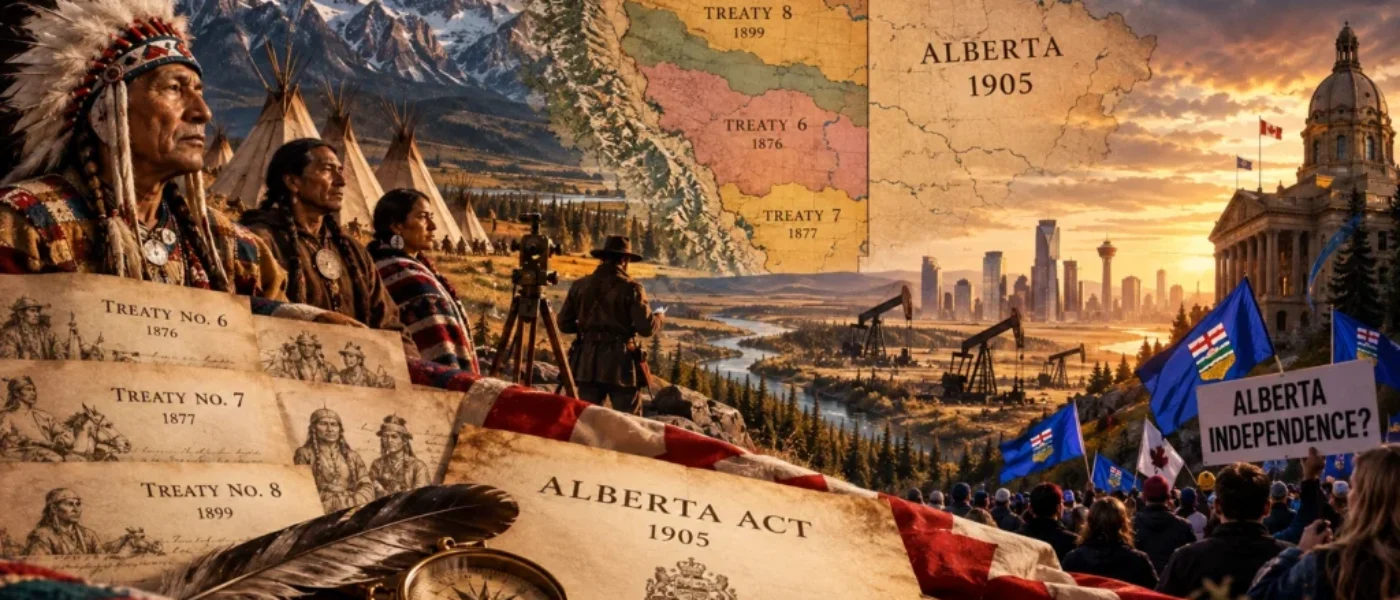
Alberta may want to leave Canada, but it cannot simply take its land and ignore the Indigenous treaties and constitutional rights that existed long before the province was created.
WHole Rabbit Hole, Three Sentences
Alberta became a province in 1905, decades after the Crown signed treaties with First Nations across much of the territory. Even if Albertans vote for independence, Canada’s Constitution requires negotiations that address Indigenous rights, provincial borders, and the interests of the rest of the country. After centuries of governments drawing lines on maps and claiming land that was already occupied, we are once again debating who actually gets to decide what happens to it.
In 1905, the Canadian government created Alberta. Parliament passed the laws, drew the provincial boundaries, established a government, and welcomed Alberta into Confederation. At the time, there was little reason to imagine that, more than a century later, some Albertans would be arguing that the province should leave Canada altogether.
Supporters of independence believe Alberta would be better off without Ottawa making decisions about federal taxes, energy policy, and other matters that affect the province. They argue that Alberta contributes more to Canada than it receives in return and should have greater control over its own future. Whether those complaints justify leaving Confederation is a debate worth having, and one that Canadians are free to disagree about.
But there is a rather important piece of history that tends to get overlooked in all this talk of independence.
Alberta was created in 1905. The treaties governing much of the territory were signed decades earlier. And the Indigenous nations whose homelands lie within its borders were there long before either event.
The province can debate its future. What it cannot do is assume that everyone else’s rights disappear because somebody has decided to draw a new national boundary.
First, Somebody Drew a Rectangle
When Alberta and Saskatchewan became provinces on September 1, 1905, the Canadian government had already decided where their borders would go. Parliament passed the legislation, and two enormous new provinces appeared on the map.
Alberta’s southern border followed the 49th parallel, separating it from the United States. To the west were the Rocky Mountains and, farther north, the 120th meridian. The eastern border followed the 110th meridian, dividing Alberta from Saskatchewan, while the northern border was set at the 60th parallel.
Within those lines lay mountains, forests, grasslands, rivers, farmland, and valuable natural resources. There were also people who had lived on and cared for these lands for thousands of years, long before anyone in Ottawa decided to call the place Alberta.
The Blackfoot Confederacy, Cree, Dene, Nakoda, and other First Nations had their own governments, communities, trade routes, and deep ties to the land. Métis communities had also grown throughout the region, building settlements, raising families, trading, and developing their own traditions and ways of life. None of this began when Parliament passed the Alberta Act.
That legislation created a provincial government and established its boundaries. It did not create the land, nor did it erase the rights of the Indigenous peoples who already lived there.
And yet, something curious happens when governments draw borders. Give a piece of land a name, a legislature, a flag, and a neat line around it on a map, and people gradually begin to think that everything inside those lines belongs to whoever runs the place.
Which is a rather convenient way of looking at history, provided you ignore everyone who was there first.
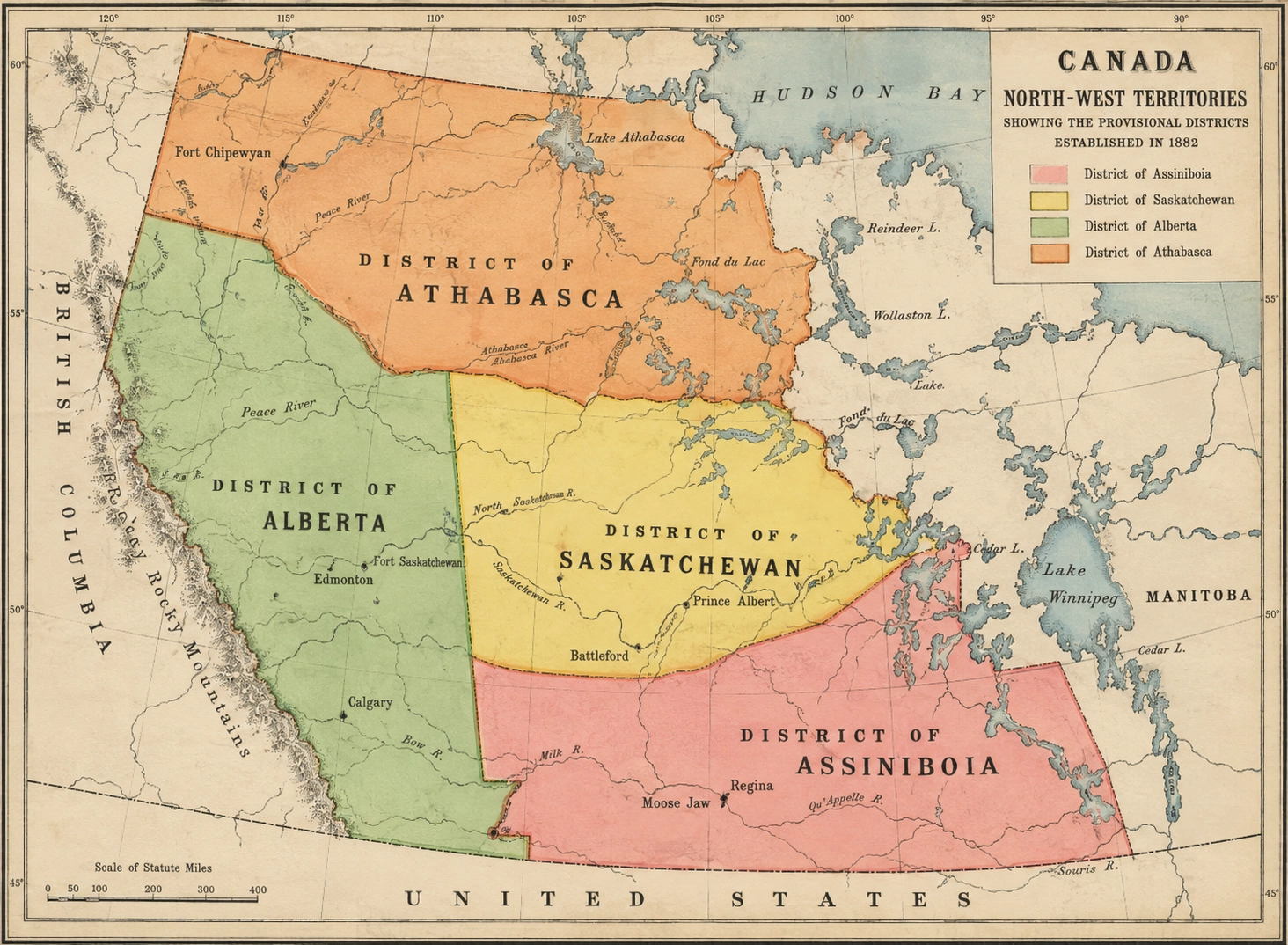
**The North-West Territories, 1882.** Unable to find a suitable historical map with clearly established reproduction rights, we used AI to create this illustrative reconstruction of the four provisional districts established in 1882: Alberta, Saskatchewan, Assiniboia and Athabasca. Yes, Alberta and Saskatchewan existed as district names 23 years before becoming provinces, alongside two others most of us have probably forgotten. The illustration is not an authentic historical map, and its geographical details have not been independently verified.
Three Treaties Alberta Cannot Pretend Never Happened
Here’s where the history becomes particularly inconvenient for anyone imagining that Alberta can simply pack its bags and leave Canada.
By the time Alberta became a province in 1905, the Crown had already entered into three major numbered treaties with First Nations across much of the territory. These agreements were signed decades before Alberta had its own legislature, premier, or provincial government.
Treaty 6 was first signed in 1876 and covers much of central Alberta and Saskatchewan. Its provisions included education, agricultural assistance, and medical care, including the well-known medicine chest clause.
Treaty 7 followed in 1877 at Blackfoot Crossing in what is now southern Alberta. The agreement involved nations of the Blackfoot Confederacy, the Tsuut’ina, and the Stoney Nakoda, whose territories and relationships with the land existed long before Canada began drawing provincial boundaries.
Treaty 8, first signed in 1899, extended across much of northern Alberta and into neighbouring regions. During negotiations, First Nations were given assurances about their ability to continue hunting, fishing, and maintaining traditional ways of life.
And this is where we need to understand something about the treaties themselves. The Crown’s written documents describe the surrender of land, but Indigenous oral histories often tell a different story: agreements to share the land, live peacefully alongside newcomers, and protect rights that were never intended to disappear. Those different understandings remain at the heart of treaty disputes today.
Whatever the disagreements over their meaning, these treaties established lasting obligations between First Nations and the Crown. In 1982, Section 35 of Canada’s Constitution Act recognized and affirmed existing Aboriginal and treaty rights, giving them explicit constitutional protection.
So when people talk about Alberta separating from Canada, there’s a rather enormous question sitting in the middle of the conversation. What happens to the treaties and the rights of the First Nations whose territories would suddenly find themselves inside a newly independent country?
Those obligations cannot simply be wished away by a provincial government, and a vote for independence would not automatically settle them. Alberta might be able to debate its relationship with Canada, but it cannot pretend that the only parties with a stake in that decision are Alberta and Ottawa.
The Constitution Has Some Rather Inconvenient Instructions
In 1998, the Supreme Court of Canada was asked to consider a rather extraordinary question: could Quebec simply decide to leave Canada, declare itself independent, and carry on as a separate country?
The Court’s answer was no, although it also recognized that a clear majority voting for independence on a clear referendum question would create a constitutional obligation to negotiate. In other words, Canadians have the democratic right to pursue political change, but a province cannot simply hold a vote and announce that the country has been rearranged.
Those negotiations would have to consider the Constitution, the interests of the federal government and other provinces, minority rights, and the rights of Indigenous peoples. There would be an enormous number of questions to settle, particularly when it came to territory, existing obligations, and the people whose futures would be affected.
In 2000, Parliament passed the Clarity Act, which established a federal framework for determining whether a referendum question and its result were sufficiently clear to justify negotiations. The legislation specifically identifies Indigenous rights, interests, and territorial claims, along with possible changes to provincial boundaries, as matters that would need to be addressed.
Now imagine that a substantial majority of Albertans voted for independence. The provincial government could not simply announce that independence would begin on Monday, assume ownership of everything within Alberta’s existing borders, and send Ottawa a forwarding address.
A lawful separation would require negotiations and constitutional changes involving other parties, none of whom would be obliged to accept every demand Alberta brought to the table. There is no guaranteed outcome, no automatic right to take the entire existing provincial territory into a new country, and no legal shortcut around the rights of Indigenous nations.
Which brings us to the rather important distinction that tends to get lost in all the excitement: the democratic right to pursue independence is not the same thing as the right to dictate the terms of departure.
Treaty 6
1876
Central Alberta & Saskatchewan
Education, agricultural assistance, and medical care, including the medicine chest clause.
Treaty 7
1877
Southern Alberta
Signed at Blackfoot Crossing with the Blackfoot Confederacy, Tsuut’ina and Stoney Nakoda nations.
Treaty 8
1899
Northern Alberta & neighbouring regions
Included assurances concerning continued hunting, fishing and traditional ways of life.
And What About the People Who Don’t Want to Leave?
There’s another rather enormous problem with the idea that Alberta could vote for independence and simply take everyone within its borders along for the ride. What happens to the people and nations who never agreed to leave Canada in the first place?
For First Nations, this question goes far beyond whether individual citizens vote yes or no in a provincial referendum. Their treaties were negotiated with the Crown, long before Alberta became a province, and those agreements established relationships and obligations that cannot simply be set aside because a majority of provincial voters want a different political future.
Indigenous citizens would be entitled to participate in a referendum under the applicable voting rules, but their individual votes and their nations’ collective treaty rights are two very different things. A provincial majority cannot simply vote those rights out of existence.
First Nations governments have repeatedly emphasized that their treaty relationships are not agreements with the provincial government of Alberta. They are relationships with the Crown, and any attempt to change the constitutional arrangements surrounding those treaties would raise serious questions about consent, territory, and the obligations of governments.
Now, this doesn’t mean that every First Nation has an automatic legal veto over Alberta’s independence. Canadian courts have not established such a straightforward rule, and nobody can say with certainty exactly how all these relationships would be resolved if Alberta genuinely pursued separation. Those questions would require difficult negotiations involving Indigenous nations, Alberta, Canada, and potentially other parties.
But the absence of a simple answer doesn’t mean Indigenous rights can be ignored. Quite the opposite. It means there are fundamental questions that would have to be addressed before anyone could pretend the matter was settled.
And there is a remarkable historical irony in all of this. During the nineteenth century, Canadian governments drew boundaries, negotiated territorial arrangements, and imposed political decisions that profoundly affected Indigenous peoples, often without securing their agreement or respecting their understanding of what had been promised.
Now, more than a century later, some supporters of Alberta independence appear to imagine that another enormous rearrangement of the country could take place simply by carrying the province’s existing borders into a new nation.
One might have hoped we’d learned something from the first exercise.
The Argument Has Returned in 2026
Alberta separatism has a long history, although it tends to grow louder whenever relations between the province and Ottawa become particularly unpleasant. Disagreements over energy policy, federal taxation, and the distribution of political power have fuelled western alienation for decades, occasionally producing movements that argue Alberta would be better off governing itself.
In 2026, those arguments have moved well beyond the occasional angry conversation about Ottawa. Alberta is preparing for a provincial referendum on October 19, and one of the ten questions asks voters whether the province should remain in Canada or begin the legal process required to hold a future binding referendum on separation.
That is an important distinction. Albertans are not voting to become an independent country on October 19. They are being asked whether their government should take the next step toward a possible future vote, a process that would still face enormous constitutional and legal obstacles.
Supporters of independence argue that Alberta could manage its resources, revenues, and political priorities more effectively outside Confederation. Opponents point to the economic uncertainty, the importance of trade and transportation across provincial borders, and the difficult question of what would happen to existing constitutional obligations. Premier Danielle Smith has stated that she supports Alberta remaining in Canada, while acknowledging the grievances that have helped fuel the separatist movement.
There is nothing unreasonable about debating how Canada is governed, questioning federal policies, or arguing that provinces should have greater control over their affairs. Those are legitimate political conversations, and Canadians have been having them since Confederation.
But there is an extraordinary difference between wanting a different relationship with Ottawa and assuming that Alberta can simply take its existing borders, resources, and population into a new country. The provincial government operates within a constitutional system that recognizes rights and obligations older than Alberta itself, and those do not disappear because a referendum produces a politically inconvenient result.
Alberta Referendum 2026
October 19, 2026 — Official Results
Albertans went to the polls on October 19 to decide whether their province should remain in Canada or begin the legal process toward a future referendum on separation.
The results were decisive.
-
74.95% voted to remain in Canada.
-
25.05% voted to begin the separation referendum process.
-
70.4% of eligible voters participated.
The referendum was not a vote for independence. It was a vote on whether Alberta should begin the process of holding another, potentially binding referendum.
Nearly three out of four voters rejected that proposal.
The result leaves Alberta firmly within Confederation, although the broader debate over provincial autonomy and relations with Ottawa continues.
One rather important detail remains: Even if Albertans had voted to pursue separation, a provincial referendum could not simply erase the constitutional rights, treaties and obligations that existed long before Alberta became a province in 1905.
Those questions would still have to be answered.
The Land Was Never Just a Rectangle
There’s a remarkable pattern running through this history, and once you begin to recognize it, the arguments over Alberta’s future start to sound rather familiar.
In 1803, Napoleon sold Louisiana to the United States for $15 million, despite the boundaries being poorly defined and the Indigenous nations living throughout those territories having no say in the transaction. In 1870, Canada acquired the Hudson’s Bay Company’s vast territorial claims through another arrangement negotiated between governments and commercial interests, while the people already living on those lands were largely excluded from the decisions being made about their future.
The Red River Resistance, led by Métis communities determined to protect their rights and way of life, forced negotiations that helped bring Manitoba into Confederation. Across the Prairies, the numbered treaties established relationships between First Nations and the Crown, along with promises and obligations that Canadian governments would repeatedly struggle, and often fail, to honour.
Then, in 1905, Parliament created Alberta and Saskatchewan, drawing new provincial boundaries across lands already shaped by generations of Indigenous history, European expansion, territorial disputes, and political decisions made far away from the people most affected.
And here we are in 2026, once again debating who gets to decide the political future of the land and everyone living on it.
There is, however, one enormous difference between the world of 1905 and the Canada of today. We now have a Constitution that explicitly recognizes Aboriginal and treaty rights, along with decades of court decisions examining the responsibilities governments owe to Indigenous peoples. Those protections don’t resolve every dispute, but they make it considerably harder for governments to pretend that the rights of others are simply inconvenient details.
Supporters of Alberta independence are entitled to argue for a different political future. They can campaign, organize, and try to persuade their fellow Albertans that leaving Confederation would be in the province’s best interests. What they cannot reasonably assume is that winning a provincial referendum would give them unquestioned ownership of every acre within Alberta’s existing borders.
Alberta can decide that it wants to leave Canada. It cannot decide, all by itself, that everybody else’s rights are coming along for the ride.
After centuries of European governments, trading companies, and politicians treating maps as though drawing a line somehow confers ownership of everything inside it, perhaps the most astonishing part of this entire story is that we’re still having to explain the difference.
Psst… WHere We’ve Been Before
This is the final article in a four-part exploration of how European land transactions, corporate privileges, Canadian expansion and provincial boundaries shaped the country we recognize today.
The story began when Napoleon sold Louisiana without clearly established borders. It continued when an English king granted the Hudson’s Bay Company sweeping powers over Rupert’s Land, and when Canada’s expansion westward collided with Louis Riel, the Métis and the treaty rights of First Nations.
The question has remained remarkably consistent.
Who gets to make decisions about land, and who is expected to live with them?
Keep Following the WHole Rabbit Hole
Missed the beginning? Or stumbled into this story wondering what the hell Napoleon has to do with Alberta?
The FuckWHittery Footnote
The history in this article is documented. Alberta’s creation in 1905, Treaties 6, 7 and 8, the Constitution Act of 1982, the Supreme Court’s 1998 Secession Reference and the federal Clarity Act are all part of Canada’s historical and legal record.
The modern debate over Alberta independence is political, and its outcome remains uncertain. The constitutional obligations are not simply matters of political preference.
Most Canadians learned the year Alberta became a province. Far fewer learned the treaties that preceded it, the rights that survived its creation, or the constitutional requirements that would govern any attempt to leave Confederation.
Because history becomes considerably more interesting when we stop asking who drew the borders and start asking whose rights those borders were drawn across.
Still Wondering WHat the Fuck?
Good. Curiosity is how we get past the headlines. Explore the treaties, the constitutional questions and the history behind Alberta separatism. Follow the evidence and see where the rabbit hole leads.
Take This Rabbit Hole to ChatGPT →The WHole Paper Trail
Because the astonishing bits of history are even better when you can check the receipts. Here are the historical and legal sources behind this article.
Government of Canada — The Alberta Act (1905) →
The legislation establishing Alberta and its original boundaries.
Supreme Court of Canada — Reference re Secession of Quebec (1998) →
The landmark decision establishing that a province cannot lawfully secede unilaterally.
Government of Canada — Clarity Act (2000) →
Addresses Indigenous rights, territorial claims and potential boundary changes in secession negotiations.
Elections Alberta — October 19, 2026 Referendum →
Official referendum information and voting details.