WHat the Fuck?
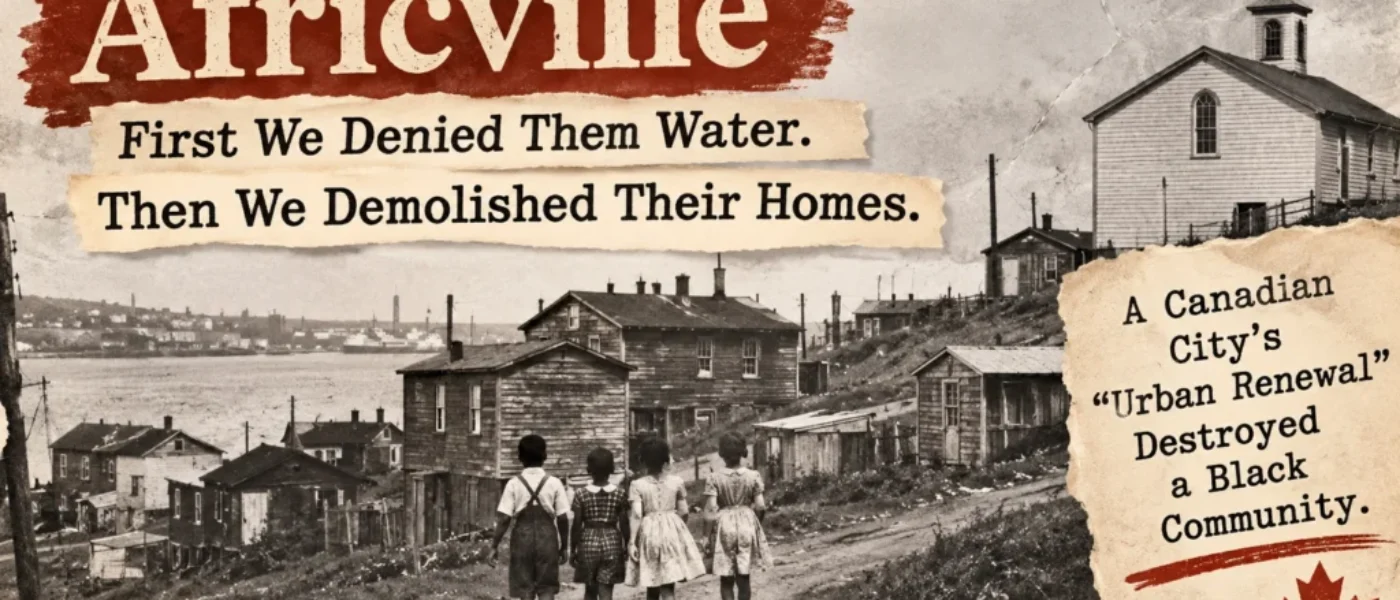
Halifax denied a Black community basic municipal services for generations, then declared the neighbourhood a slum and demolished it in the name of progress.
WHole Rabbit Hole, Three Sentences
For more than a century, Black families in Africville built homes, raised children, paid taxes and created a community on the shores of Halifax Harbour. The city failed to provide basic services, allowed a dump and other undesirable facilities nearby, then used the neighbourhood’s deteriorating conditions to justify removing its residents. Between 1964 and 1970, Africville was demolished in the name of urban renewal, leaving families displaced and a community destroyed by the very government that was supposed to serve it.
AFRICVILLE / 01
A Community Before the City Decided Otherwise
On the northern shore of Halifax’s Bedford Basin, Black families built a community that would become known as Africville. Recorded land purchases date to 1848, although family histories reach further back. Many residents had roots among Black Loyalists and Black Refugees who came to Nova Scotia in earlier generations.
Africville was not an empty stretch of shoreline waiting for a city plan. Families owned homes, tended gardens, ran small businesses and raised children. The Seaview United Baptist Church became a gathering place for worship, celebrations and the ordinary business of belonging somewhere.
Some residents called the settlement Campbell Road. The origin of the name Africville is less certain, but it became the name by which this predominantly Black community was known.
A neighbourhood is not a problem simply because the people living there are poor.
AFRICVILLE / 02
Taxes Collected. Services Not Included.
Africville residents paid municipal taxes and repeatedly asked Halifax for the services available in other neighbourhoods. Piped water, sewers, proper garbage collection, paved roads and adequate street lighting remained absent.
Families relied on wells and springs for water. As industry spread around the community, contamination became a serious concern. Residents were asking for the basic things a city is supposed to provide, not special treatment.
In 1948, Halifax approved money for water and sewer services. The services were never installed.
1948 — Halifax approved funding for water and sewer services. Africville still did not receive them.
AFRICVILLE / 03
An Excellent Place for Everything Nobody Else Wanted
As Halifax grew, railway lines and industrial uses pressed into Africville. A prison, a slaughterhouse and an infectious disease hospital were placed in or near the community. In the mid-1950s, the city moved its open dump close to residents’ homes and church.
Imagine trying to maintain a house and raise children while the municipality withholds services and places its least desirable facilities next door. The resulting conditions did not appear by magic. They followed years of decisions about where to spend money and where to put the things other neighbourhoods did not want.
In 1947, the city designated Africville land for industrial use even though families still lived there. The future being planned for the area increasingly had no room for the people already calling it home.
First came the neglect. Then came the dump. Eventually came the verdict: slum.
AFRICVILLE / 04
The City Discovers a Slum
By 1958, Africville had been officially labelled a slum. Halifax officials argued that relocating residents would improve housing and living conditions. Urban renewal was fashionable across North America, and the language of improvement gave demolition a respectable name.
Some people outside Africville, including civil-rights advocates, supported relocation because they saw the community’s poor services and segregation as intolerable. Residents themselves did not all share one opinion. Many wanted better conditions without losing their land, neighbours and independence.
A 1959 survey found that 65 percent of residents questioned liked living in Africville and did not want to move. That was not the answer the city’s plans were built around.
The city had an opportunity to improve the neighbourhood. It chose to remove it.
AFRICVILLE / 05
A Price for a Home. No Price for Belonging.
Halifax approved relocation, and the first property purchases began in 1964. Residents with recognized deeds could negotiate payment for their property. Those without formal proof of title, including families whose homes had passed through generations, were often offered only $500. Expropriation remained a possibility for people who resisted.
The city promised improved housing and opportunities. Some families initially welcomed the prospect of better accommodation, but the results were uneven. Many ended up renting or in public housing rather than owning a home. A payment for a building did not replace land, family networks or a community built over generations.
In one of the most humiliating details of the relocation, municipal dump trucks were used to carry some residents’ belongings.
The same city that placed a dump beside their homes used dump trucks to move some of them out.
AFRICVILLE / 06
Then They Bulldozed the Church
The Seaview United Baptist Church was more than a building. It held the weddings, funerals, worship services and memories of families who had lived in Africville for generations.
On November 20, 1967, the church was demolished in the middle of the night. By then, much of Africville had already been cleared. The final resident, Aaron “Pa” Carvery, left at the beginning of 1970.
About 400 people from roughly 80 families had been uprooted. The houses were gone. The streets and familiar meeting places were gone. The community could not simply be reassembled somewhere else.
Urban renewal could clear the land. It could not replace what had been destroyed.
AFRICVILLE / 07
The Bill for Progress
The irony is preserved in the numbers. Canada’s History reports that the 1964–1970 relocation cost about $800,000—the same amount Halifax had considered too expensive for upgrading Africville’s services in 1963.
The land was eventually used for transportation and other development, while part of the former community became parkland. For displaced residents, the consequences extended far beyond the loss of a house. Homeownership, family connections and the ability to pass property to children had all been affected.
Residents organized to demand recognition and redress. Their efforts kept Africville’s history alive long after its buildings disappeared.
The money could be found to remove the people. Finding it to serve them had been another matter.
AFRICVILLE / 08
An Apology Does Not Rebuild a Neighbourhood
In 2010, Halifax formally apologized for the destruction of Africville and committed support toward rebuilding a representation of the Seaview church. The reconstructed building now houses the Africville Museum, preserving the stories of residents and their descendants.
The apology mattered. So did the long campaign that made it possible. Neither changed the fact that a Canadian city had spent generations withholding ordinary services from a Black neighbourhood before declaring that neighbourhood unfit to survive.
Africville belongs beside the other Canadian stories of progress that came at someone else’s expense. A town flooded for electricity. A community moved for modernization. A neighbourhood demolished for renewal. The official vocabulary changes. The people who pay the price are rarely the ones who choose the plan.
Halifax did not have to destroy Africville to give its residents clean water.
The City Created the Problem. Then Removed the People.
For generations, Black families built a community in Africville on the shores of Bedford Basin. They raised children, worshipped together and made homes in a neighbourhood the City of Halifax repeatedly failed to serve with basic infrastructure.
Rather than provide the services residents had long sought, the city approved the removal of Africville in the name of urban renewal. Homes disappeared, families were scattered and the community’s church was demolished. The conditions used to justify clearing the neighbourhood had been shaped, in part, by the city’s own decisions.
Keep Following the WHole Rabbit Hole
Africville was not the only Canadian community to learn that someone else’s idea of progress could cost people their homes. These stories follow other decisions made from a distance, and the lives changed by them.
The FuckWHittery Footnote
The story of Africville is not a tale of a neighbourhood that simply disappeared. People lived there, built homes and asked their city for services. Municipal decisions helped make everyday life harder, while urban renewal eventually provided the justification for taking the community apart.
The dates, decisions and testimony survive in public archives and in the work of Africville’s descendants. Halifax apologized in 2010, but an apology cannot return the childhoods, homes or years of community life that were lost.
Most of us did not learn this part of Canadian history in school. We think we should have. Because history is easier to remember when we look at what people in authority actually decided to do—and who was left to live with it.
Still Wondering WHat the Fuck?
Follow the history of Africville: the Black families who built the community, the municipal services they were denied, the dump placed nearby, the relocation program, the demolition of Seaview Baptist Church and Halifax’s eventual apology. Ask what the surviving records reveal about who made the decisions and how residents experienced them.
Take This Rabbit Hole to ChatGPT →The WHole Paper Trail
Africville’s history survives in photographs, records, community testimony and the work of descendants who refused to let the neighbourhood be forgotten. These collections are places to begin.
Nova Scotia Archives — Africville →
Archival photographs, documents and historical material about the community and its removal.
Africville Museum →
Community history, remembrance and the ongoing work of preserving Africville’s legacy.
Canadian Museum for Human Rights — The Story of Africville →
The history of displacement, racial discrimination and the struggle for recognition.