WHat the Fuck?
In 1670, King Charles II handed a private fur-trading company sweeping rights over nearly four million square kilometres of North America, without consulting the people living there. Two hundred years later, Canada paid the company £300,000 to surrender those privileges. The company eventually became the department store where Canadians bought towels.
WHole Rabbit Hole, Three Sentences
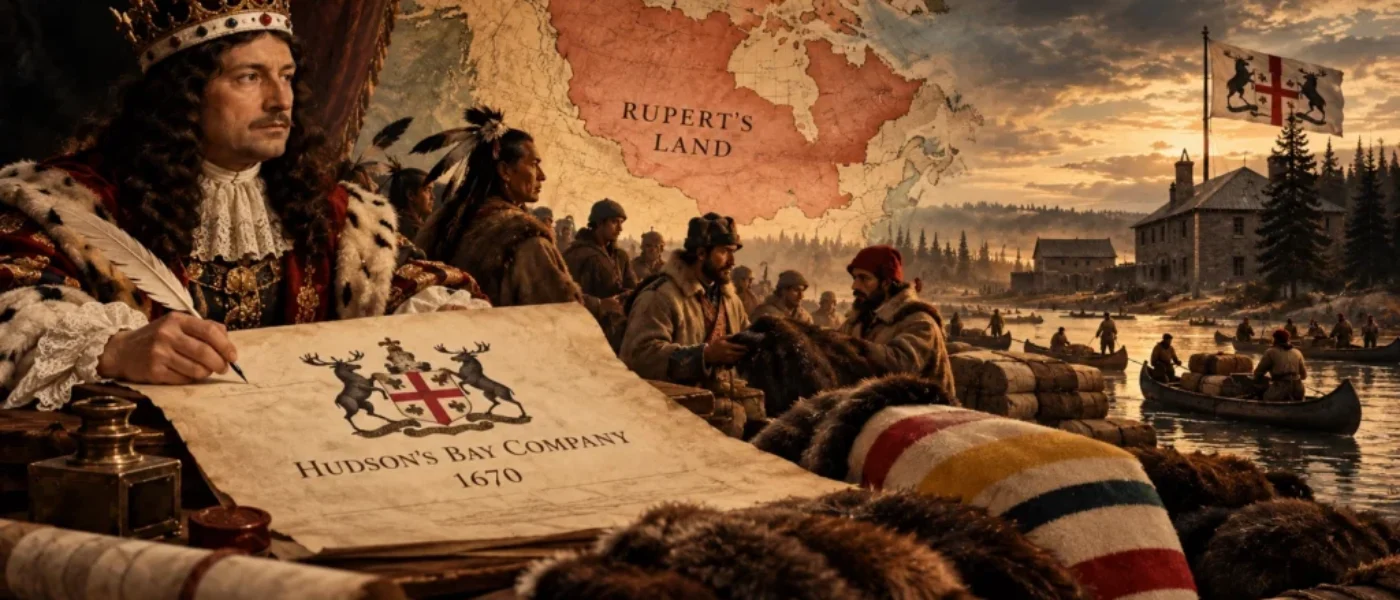
In 1670, King Charles II granted the Hudson’s Bay Company a royal charter giving it exclusive trading rights and extraordinary governing powers across Rupert’s Land, an enormous territory already inhabited by Indigenous nations with their own governments, laws and trading networks.
Nearly two centuries later, Canada negotiated to acquire the company’s territorial claims, paying £300,000 while allowing the company to retain valuable land interests, including rights to five per cent of the designated Fertile Belt.
The Indigenous peoples and Métis communities whose homelands were being transferred had no equivalent voice in the negotiations, setting the stage for resistance, broken promises and a struggle over land and political rights that would shape Canada’s future.
The King Who Gave Half a Continent to a Department Store
In 1670, King Charles II of England granted a group of wealthy investors the exclusive right to trade across nearly 3.9 million square kilometres of North America. The territory was larger than modern India and covered roughly one-third of present-day Canada.
The investors formed a company with the rather grand name of the Governor and Company of Adventurers of England Trading into Hudson’s Bay.
Today, we know it as the Hudson’s Bay Company, the same business that eventually sold blankets, furniture, kitchen appliances, perfume, winter coats and wedding gifts to generations of Canadians.
Long before it became a department store, the Hudson’s Bay Company held powers normally reserved for governments. It could build forts, appoint officials, make rules and control trade across an enormous territory. Those powers came from a king who had never visited the land and had no agreement with the people living there.
Nearly two centuries later, Canada paid the company to give up those powers.
A king had granted a private business rights over a vast part of North America. When Canada wanted those rights, the government had to pay the company £300,000 to surrender them.
The people who already lived on the land were not included in the negotiations.
His Majesty Was Feeling Generous
On May 2, 1670, Charles II signed a royal charter creating the Hudson’s Bay Company. Among its powerful supporters was Prince Rupert, the king’s cousin, who became the company’s first governor. The territory covered by the charter became known as Rupert’s Land in his honour.
The charter covered lands whose rivers and streams drained into Hudson Bay, apart from areas claimed by other Christian rulers. This vast region included parts of what would later become Manitoba, Saskatchewan, Alberta, Ontario, Quebec and the Northwest Territories.
The king gave the company exclusive trading rights, along with the power to build forts, appoint officials, settle disputes and make rules for its operations. This was far more than permission to trade furs. Charles II had created a private business with powers normally held by a government.
There was one enormous problem with the arrangement. The land was already inhabited.
Cree, Anishinaabe, Inuit, Dene and many other Indigenous peoples had lived across these territories for generations. They had their own governments, laws, trade routes, economies and relationships with the land. Their communities had developed long before Europeans began drawing maps of North America.
None of these nations had given Charles II permission to hand their territories to a group of English investors. The king issued the charter anyway, and European maps soon carried the name of an English prince across lands that already had names, histories and peoples of their own.
The Fur Trade Wasn’t Invented in London
The Hudson’s Bay Company’s success depended on trade networks that Indigenous peoples had built long before the company existed.
For centuries, Indigenous nations had exchanged goods, materials and information across North America. These networks connected distant communities through trade routes, rivers and overland trails. Indigenous traders understood the geography, seasons, wildlife and travel conditions that European merchants were only beginning to learn.
European demand for beaver fur made these networks extremely valuable. Beaver pelts could be turned into felt for fashionable hats, and wealthy Europeans were willing to pay high prices for them.
The Hudson’s Bay Company built trading posts along the shores of Hudson Bay. Indigenous traders brought furs to these posts and exchanged them for metal tools, firearms, cloth, kettles and other European goods.
The company relied heavily on Indigenous hunters, traders, guides and families to keep the business running. Many travelled great distances to bring furs to the trading posts. Others supplied food, helped company workers travel safely and shared knowledge needed to survive harsh northern winters.
Indigenous women also played important roles in the fur trade. Through family relationships, trade and diplomacy, they helped build connections between communities and European traders. Their knowledge and work supported an industry that would become one of the most important businesses in British North America.
The company’s investors provided money and ships, while its employees operated trading posts and kept records. Much of the work that made the fur trade possible, however, depended on Indigenous peoples.
The royal charter gave the Hudson’s Bay Company enormous powers on paper, but those powers did not mean it controlled every community or river within Rupert’s Land. For much of its early history, the company depended on Indigenous people choosing to trade with it.
A royal signature in London could create a legal claim under British law. It could not make millions of square kilometres of inhabited territory suddenly belong to a company in practice.
Two Hundred Years Is a Long Time to Hold a Royal Favour
By the nineteenth century, the Hudson’s Bay Company had become one of the most powerful businesses in British North America.
In 1821, it merged with its main rival, the North West Company, after years of fierce competition that sometimes turned violent. The combined business controlled much of the British North American fur trade, with trading posts spread across a vast region.
The company had grown far beyond the small group of investors who received the royal charter in 1670. Its employees, traders and their families had helped establish communities and trading centres throughout the interior of North America.
During the 1800s, however, the value of western land was changing. The fur trade remained important, but governments and investors were becoming interested in farming, railways, minerals and permanent settlements.
Canada became a country in 1867, when Ontario, Quebec, Nova Scotia and New Brunswick joined Confederation. The new federal government soon began planning to expand westward.
Canadian politicians wanted a country that stretched across the continent. They hoped railways, farms and new settlements would strengthen the economy and connect the eastern provinces to the Pacific coast. They also feared that the United States might expand northward into territories Britain claimed.
Much of the land Canada wanted was still covered by the Hudson’s Bay Company’s royal charter.
The company had held its privileges for nearly two hundred years and had no intention of giving them up without payment.
Canada Went Shopping for a Country
Negotiations between Canada, Britain and the Hudson’s Bay Company led to an agreement called the Deed of Surrender.
Under this agreement, the company would give up its territorial and governing rights in Rupert’s Land, along with its claims in the North-Western Territory. These changes would allow Britain to transfer the territories to Canada.
In exchange, the Hudson’s Bay Company received £300,000.
The payment was only part of the deal.
The company was allowed to keep its trading posts and certain lands around them. It also received the right to claim one-twentieth of the land in a region known as the Fertile Belt as the territory was surveyed and prepared for settlement.
One-twentieth meant five per cent of the land in that designated region.
The agreement was not a simple purchase of every acre. Canada was acquiring the company’s chartered rights and claims, while the company kept valuable land interests that could benefit from future settlement and development.
The arrangement was remarkable. In 1670, a king had granted a private company sweeping powers over a huge part of North America. Nearly two hundred years later, those same powers stood in the way of Canada’s plans to expand west.
Rather than challenge the company’s privileges, Canada negotiated a payment to end them. The company received £300,000, kept its trading posts and gained valuable land rights.
On July 15, 1870, Rupert’s Land and the North-Western Territory formally became part of Canada.
The Hudson’s Bay Company remained in business, no longer governing a vast territory but still holding commercial interests across the West.
The royal charter had helped the company build its wealth and influence. Giving up the chartered rights brought another financial reward, along with land that could grow in value as settlement expanded.
For a company whose original advantage came from the generosity of an English king, the outcome was remarkably profitable.
The People Missing From the Negotiations
The agreement between Britain, Canada and the Hudson’s Bay Company left out the people whose lives would be most affected.
Indigenous nations had not collectively agreed to the transfer of their territories. Métis communities, whose families had built farms, settlements and political institutions across the region, were also excluded from the negotiations.
Canada treated the agreement as a way to gain control of western territory. Under British colonial law, the Hudson’s Bay Company could surrender its chartered claims, allowing the Crown to transfer authority to the Canadian government.
That did not settle the rights of the people who already lived there.
Indigenous nations had their own relationships with the land, along with rights, laws and political systems that existed long before the Hudson’s Bay Company. Those rights could not simply disappear because a private business had reached an agreement with two governments.
The Métis also had established communities, farms and political interests that were threatened by Canada’s plans.
At the Red River Settlement, Métis residents were already organizing against the transfer. They feared that a distant government would take control of their lands and communities without protecting their rights or allowing them to take part in decisions.
Their concerns were not about the future of a fur-trading company. They were about who would govern their homes, protect their land and decide what happened to their communities.
The agreement that looked like a successful business deal in London and Ottawa had far more serious consequences for the people living in the territories being transferred.
The Department Store That Outlived Its Empire
The Hudson’s Bay Company continued operating long after it gave up its territorial powers. Over time, it became one of Canada’s best-known retailers, with department stores in cities across the country.
Its striped blankets became familiar Canadian symbols. Generations of families bought clothing, furniture, household goods and Christmas gifts in its stores. The company became part of everyday Canadian life, far removed from the fur-trading empire created by a royal charter in 1670.
Yet the department store and the colonial trading company were the same business.
The familiar retail chain had begun as a private company given extraordinary powers over a vast part of North America. Its wealth and influence had grown through the fur trade, supported by Indigenous knowledge, labour and trading relationships.
When Canada wanted the company’s territorial claims, it paid to acquire them. The Hudson’s Bay Company received compensation and kept valuable land interests, while Indigenous nations and Métis communities were left to defend rights that had never been properly considered in the negotiations.
The king granted the privileges. The company profited from them. Canada paid to acquire them.
The people who had lived on those lands for generations were left to challenge decisions made without their consent.
Psst… Canada Had Barely Finished Paying When the Trouble Started
The transfer of Rupert’s Land was not a peaceful change of government. At Red River, Louis Riel and the Métis had already challenged Canada’s attempt to take control without consulting the people who lived there.
Their resistance helped bring about the creation of Manitoba in 1870, but disputes over land, political rights and promises made during that period continued for years. The consequences would eventually follow Louis Riel all the way to the gallows.
Next: Canada Bought the Land. Somebody Forgot to Tell the People Living There.
Psst… Canada Had Barely Finished Paying WHen the Trouble Started
The transfer of Rupert’s Land was not a peaceful administrative formality.
At Red River, Louis Riel and the Métis had already challenged Canada’s attempt to assume control without consulting the people living there. Their resistance helped force the creation of Manitoba in 1870, but the promises made during that process would become the source of bitter disputes.
The consequences would follow Riel all the way to the gallows.
Keep Following the WHole Rabbit Hole
Missed the beginning? Or stumbled into this story wondering what the hell Napoleon has to do with Alberta?
The FuckWHittery Footnote
The events in this story are real. The royal charter, the territorial claims, the £300,000 compensation and the company’s retained land interests are documented in historical records.
Most Canadians remember the Hudson’s Bay Company as a department store. Far fewer were taught that its origins lay in a royal charter granting a private company extraordinary commercial and governing powers over an enormous region already inhabited by Indigenous nations.
The most astonishing part is not that a seventeenth-century king believed he could grant those rights.
It is that two hundred years later, governments were still treating those claims as assets that could be negotiated and compensated, while the people who actually lived there fought to have their rights recognized.
History becomes considerably harder to forget when we examine who was allowed to make the decisions, who collected the money, and who was expected to live with the consequences.
Still Wondering WHat the Fuck?
The Hudson’s Bay Company was far more than a fur-trading business. Its royal charter gave it extraordinary powers over a vast part of North America, even though Indigenous nations had lived and traded across these lands for thousands of years. Explore how the company gained its powers, how Indigenous knowledge and trade networks helped build its wealth, and why Canada paid £300,000 to acquire its territorial claims in 1870. Discover what the company kept, who was excluded from the negotiations, and how this extraordinary business deal helped shape the country we know today.
Take This Rabbit Hole to ChatGPT →The WHole Paper Trail
The royal charter, the money, the land and the agreements were all recorded. These historical documents explain how the Hudson’s Bay Company gained its extraordinary powers, what Canada paid to acquire them, and how Indigenous nations were affected by decisions made without their consent.
Government of Canada — Original Deed of Surrender →
The original legal document recording the Hudson’s Bay Company’s surrender of its territorial rights and governing powers, clearing the way for the transfer of Rupert’s Land to Canada in 1870.
Government of Canada — Terms of the Transfer →
The official terms of the agreement, including Canada’s £300,000 payment, the company’s right to keep its trading posts, and its claim to one-twentieth of the land in the designated Fertile Belt.
Crown-Indigenous Relations — Treaty One and Treaty Two Research →
Historical research on the first two numbered treaties, signed in 1871. These records help explain the negotiations between Canada and First Nations after the transfer of Rupert’s Land, including disputes over land, promises and treaty rights.
Encyclopedia of the Great Plains — Hudson’s Bay Company →
Explores the company’s history as a major fur-trading business, its relationships with Indigenous peoples, and its later expansion into land development and retail. It connects the company’s colonial past with the department stores familiar to generations of Canadians.