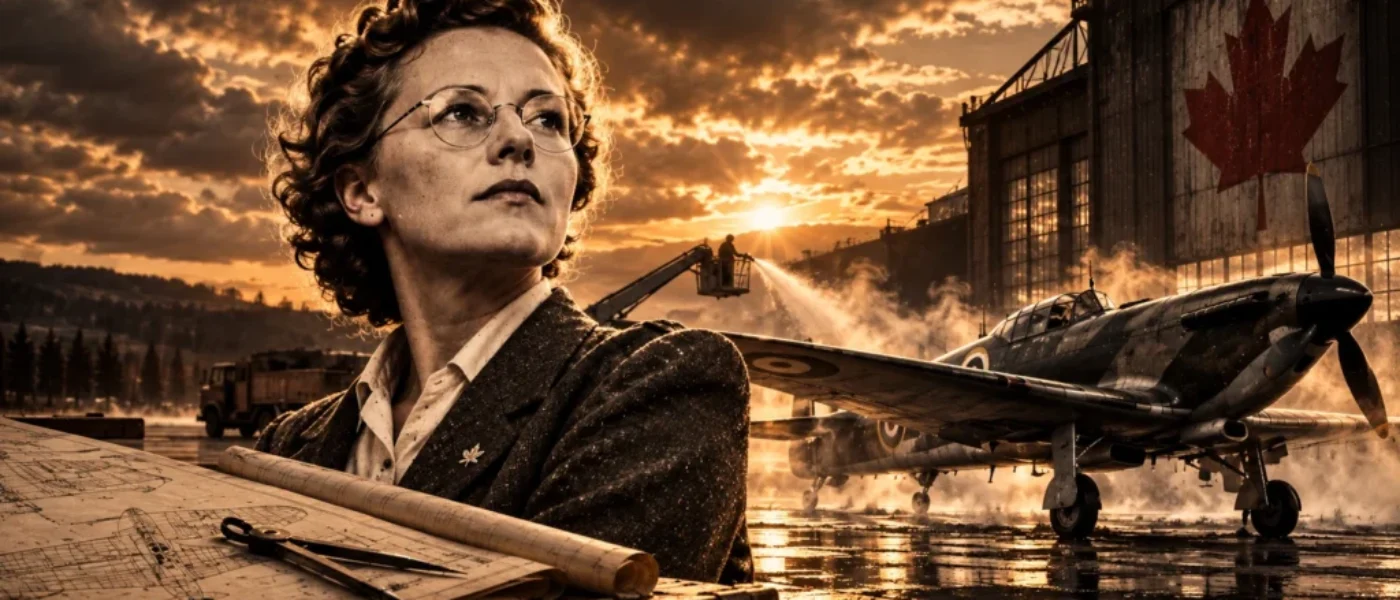
Most Canadians have watched an airplane being de-iced. We sit at the gate on a miserable February morning while great mechanical arms move around the aircraft, spraying the wings before takeoff, and although we may grumble about the delay, none of this seems particularly remarkable anymore. Nor does the sight of a small aircraft sitting on floats at a northern lake, or one fitted with skis for landing on snow. These things belong so completely to the landscape of Canadian aviation that we barely think about the engineering problems behind them: ice changes the shape and performance of a wing; conventional landing gear is not terribly useful when the ground beneath you is snow, ice or water; engines, controls and materials behave differently when temperatures plunge. Flying in Canada required engineers to solve problems that aviation elsewhere did not always have to solve.
One of the people solving those problems was a Canadian woman named Elsie MacGill, and the fact that her name is not as immediately recognizable to Canadians as Alexander Graham Bell, Frederick Banting or Amelia Earhart is one of those peculiar failures of historical memory that becomes more irritating the more you learn about her.
Elizabeth Muriel Gregory MacGill was born in Vancouver in 1905, the daughter of Helen Gregory MacGill, herself a formidable woman who had worked as a journalist, fought for women’s suffrage and legal reform, and became the first woman appointed as a judge in British Columbia. Elsie therefore grew up in a household where the boundaries placed around women were not necessarily accepted simply because society had declared them reasonable. In 1923 she entered engineering at the University of Toronto, at a time when women entering the profession were still regarded as an anomaly. Four years later she graduated in electrical engineering, becoming the first woman in Canada to earn that degree.
Electrical engineering might have been achievement enough, particularly in 1927, but aviation had caught MacGill’s attention. Powered flight itself was still astonishingly young. Only twenty-four years had passed since the Wright brothers’ first flight, and engineers were still working out what aircraft could become, how they could be built safely and reliably, and how they could be adapted to environments their earliest designers had scarcely contemplated. MacGill went to the University of Michigan to study aeronautical engineering and, in 1929, became the first woman in North America to earn a master’s degree in the field.
She accomplished that while recovering from polio.
MacGill contracted the disease while still in her twenties, before the vaccines that would eventually make polio almost unimaginable to later generations. It could kill within days, leave survivors permanently paralyzed or destroy the muscles required to breathe. MacGill’s doctors believed she might never walk again. For a young engineer planning a career in aviation, the diagnosis might reasonably have ended everything she had been working toward. Instead, she spent years recovering, eventually learned to walk with two metal canes, completed her graduate work and continued her studies at MIT. Polio permanently changed the way she moved through the world; it did not determine what she would do in it.
By the 1930s MacGill was working in Canada’s developing aircraft industry, including at Fairchild Aircraft in Quebec, where aviation presented problems that were distinctly Canadian. This was a country of immense distances, thousands upon thousands of lakes, isolated northern settlements, mining and forestry operations, deep snow and brutal winter temperatures. Much of it had no convenient runway waiting at the other end of a flight. Canadian aircraft therefore had to function on floats and skis and operate in conditions where ice and cold were not unusual emergencies but ordinary engineering realities. MacGill’s work included these problems of cold-weather aviation, and they would follow her into the most extraordinary period of her career.
In 1938 Canadian Car & Foundry hired MacGill as its Chief Aeronautical Engineer at Fort William, now part of Thunder Bay. She was thirty-three years old, walked with canes, and had been placed in charge of aeronautical engineering at a major Canadian manufacturer at a time when many women were still expected to abandon professional careers upon marriage. The following year the company produced the Maple Leaf II Trainer, an aircraft designed under MacGill’s leadership and generally recognized as making her the first woman to lead the design of an aircraft.
Then Europe went to war, and everything changed.
When Germany invaded Poland in September 1939, Britain urgently needed fighter aircraft. One of the most important was the Hawker Hurricane, an aircraft that would become central to Britain’s defence during the Battle of Britain. The Spitfire eventually acquired more glamour in popular memory, but Hurricanes carried an enormous share of the fighting, and Britain needed far more of them than its own factories could produce. Canadian Car & Foundry was contracted to manufacture Hurricanes at Fort William, which created an extraordinary industrial problem: a company with roots in manufacturing railway equipment now had to establish the mass production of sophisticated combat aircraft while the world was at war.
That transformation required far more than receiving British drawings and telling workers to start building airplanes. A Hurricane contained thousands of components that had to be manufactured to precise tolerances and assembled in exactly the right sequence. British components were not necessarily available from Canadian suppliers; drawings changed as aircraft were modified; manufacturing methods had to be developed; workers had to be trained; and the production line had to keep moving while engineering problems were solved around it. A railway car with a manufacturing defect is a serious problem. A fighter aircraft with a manufacturing defect can kill its pilot several thousand feet above the ground.
The Chief Aeronautical Engineer responsible for helping make that transition work was Elsie MacGill.
Under her engineering leadership, the Fort William plant became a major Hurricane production facility, eventually manufacturing more than 1,400 aircraft. At peak production the plant was turning out approximately three fighters a day with a workforce numbering in the thousands. MacGill also worked on modifications required for Canadian production and on adaptations for cold-weather operation, including de-icing systems and ski-equipped Hurricanes. She did not invent aircraft de-icing, nor did she invent floats or skis for aircraft, and there is no reason to manufacture those claims for her. What she actually did is considerably more impressive: she became one of the engineers who took technologies still being developed and refined and made them function reliably under Canadian conditions while simultaneously helping transform a railway-equipment factory into a wartime aircraft-production operation.
Her work earned her the nickname “Queen of the Hurricanes,” and in 1942 she was famous enough to appear in True Comics. Canadians living through the war could therefore encounter a woman engineer with polio being celebrated in popular culture for helping build the fighter aircraft crossing the Atlantic.
Somehow, over the following generations, most of us managed to forget her.
That is where the story becomes particularly strange, because MacGill’s importance did not end with the war. After leaving Canadian Car & Foundry in 1943, she established an engineering consulting practice in Toronto and continued working in aeronautics. In 1946 she became the first woman to serve as a technical adviser to the International Civil Aviation Organization, where her work included international airworthiness regulations for commercial aircraft. It is difficult to make phrases such as airworthiness regulations sound exciting, but perhaps that is precisely the point. Modern aviation became ordinary because engineers made it ordinary. Aircraft became machines in which millions of people could confidently cross countries and oceans because manufacturing, maintenance, testing and safety standards were painstakingly developed, standardized and shared internationally. MacGill participated in that transformation.
There is something wonderfully Canadian about the fact that we now encounter the problems she worked on without giving them a second thought. We watch an aircraft being de-iced at Pearson and complain because it is delaying our departure. We recognize a floatplane tied to a dock as instantly as we recognize a canoe. We understand why an aircraft operating in the North might need skis. The solutions became familiar enough to disappear into everyday life, while the woman who spent her career helping Canadian aviation confront those conditions largely disappeared from popular memory with them.
MacGill could have finished there and still deserved a substantial place in Canadian history. Instead, having spent decades proving that women were perfectly capable of doing work society had once considered unsuitable for them, she turned increasingly toward the laws and institutions that continued treating women as though that question remained unsettled.
In 1967 the federal government established the Royal Commission on the Status of Women in Canada, and MacGill was appointed as one of its seven commissioners. The commission travelled across the country, heard testimony from Canadians and examined women’s position in employment, education, taxation, pensions, family law and public life. MacGill advocated for women’s economic independence, equal opportunity and reproductive rights. There is a particularly bitter absurdity in this part of her story. Canada had trusted her engineering judgment when fighter aircraft were being sent into combat; international aviation organizations had accepted her technical expertise when developing standards intended to keep aircraft and passengers safe; yet women of her generation were still required to argue that they should possess economic and legal independence equal to that of men.
MacGill died in 1980 after a life that should have made her one of the standard names in Canadian history. She had survived polio, become Canada’s first female electrical engineering graduate, earned an advanced degree in aeronautical engineering when powered flight itself was barely a generation old, designed an aircraft, served as Chief Aeronautical Engineer of a wartime factory, helped oversee the production of more than 1,400 Hurricanes, worked on cold-weather aviation, contributed to international aviation standards and then helped investigate and dismantle institutional barriers facing Canadian women. She was made an Officer of the Order of Canada, inducted into Canada’s Aviation Hall of Fame, designated a National Historic Person and, in 2023, finally appeared on a Canadian one-dollar coin.
So this is not a story about a woman whose accomplishments were completely erased. Canada preserved Elsie MacGill in archives, museums, honours, historic designations and eventually on its currency. The fuckwhittery lies somewhere more uncomfortable: we preserved the record without preserving the familiarity.
We taught generations of Canadian children the same small collection of inventors, explorers, politicians and military figures while a woman who had done something almost preposterously difficult sat quietly in the historical record. We taught the history of the Second World War without making the Queen of the Hurricanes a household name. We taught children about aviation without ensuring that they knew Canada had produced one of the world’s pioneering women aeronautical engineers. We celebrated women entering factories during the war while somehow allowing a woman who was actually running the fucking engineering department to become comparatively obscure.
Perhaps most astonishing is that polio is almost incidental by the time her story is finished. In another person’s biography, learning to walk again after being told you might never do so could be the defining accomplishment of a lifetime. In Elsie MacGill’s, it occupies a few paragraphs between becoming Canada’s first female electrical engineering graduate and becoming Chief Aeronautical Engineer of a factory that would build fighter planes for a world war.
She did not need history to turn her into a feminist symbol or inflate her achievements after the fact. She had already done the work. She walked into rooms where almost everyone was a man, using two metal canes because polio had tried to take away her ability to walk, and became the person responsible for the engineering.
That should have been enough to make every Canadian kid know her name.
Elsie MacGill. Canadian engineer. Polio survivor. Aircraft designer. Women’s-rights advocate. Queen of the Hurricanes.
How the fuck did we not learn about her?
PSSTTT…
Did you see MacGill and immediately wonder the same thing I did?
Oooo… was McGill University named after Elsie? And we’ve somehow forgotten THAT too?
Nope.
McGill University was named after James McGill, a Scottish-born Montreal merchant whose bequest helped establish the university in 1821.
Elsie was MacGill. James was McGill.
For one brief, glorious moment, I thought Canada might have named one of its most famous universities after the polio-surviving aeronautical engineer who helped build thousands of Hurricanes and became known as the Queen of the Hurricanes.
But no.
It was James.
Of fucking course it was James.
Fuckwhittery Footnote
Want to go down the Elsie MacGill rabbit hole yourself? Ask ChatGPT to tell you more about Elsie MacGill and follow the sources wherever they take you.
Start with the archival record, not the mythology. MacGill’s documented achievements are remarkable enough without embellishment: Parks Canada credits her with major contributions to Hurricane mass production and later international airworthiness regulations, while Library and Archives Canada preserves her papers, technical drawings, correspondence and photographs.
Because the best part of history isn’t being told what happened. It’s discovering just how much nobody fucking told you.