There is a name for the long struggle between Britain and Russia for power in Central Asia: the Great Game.
It sounds rather grand. For the people living between those empires, it was considerably less fun.
Britain ruled India and feared Russia might move towards it. Afghanistan lay between the two. So British leaders decided they needed an Afghan ruler they could trust.
In 1839, they invaded Afghanistan, removed its ruler, Dost Mohammad Khan, and put Shah Shuja on the throne. This began the First Anglo-Afghan War, which lasted until 1842.
Then came the truly grandiose bit. The British did not simply bring soldiers and leave. They stayed in Kabul with officials, servants, workers, wives, children, and the many other people needed to run a large household and an army camp.
They behaved as if they had moved in.
No one had invited them to move in.
The people of Afghanistan had their own ruler, their own lives, and limited food and supplies. Yet now they were expected to make room for an occupying force and its households. British leaders seemed surprised when Afghans grew angry.
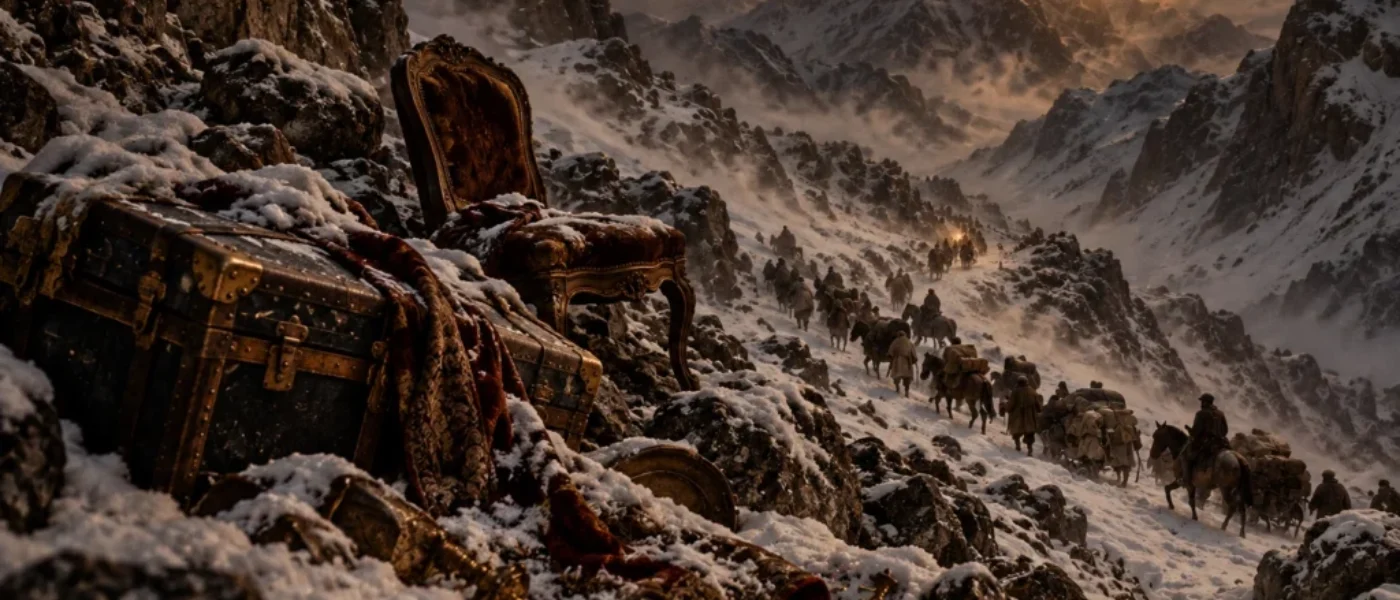
By the winter of 1841–42, the force in Kabul had to leave. On January 6, 1842, about 4,500 British and Indian soldiers set out with roughly 12,000 camp followers. That term covers the servants, workers, families, and others who had kept the camp running. Many were Indian.
Close to 17,000 people headed towards Jalalabad through mountain passes in winter.
They had been promised safe passage, along with food, fuel, and an escort. When they left Kabul, those supplies and that escort were nowhere to be found.
Over the following week, the column was attacked as it struggled through snow and bitter cold. People died, were separated from the group, or were taken prisoner. At Gandamak, the last group of soldiers made its final stand.
On January 13, a wounded army doctor named William Brydon reached Jalalabad. The image of one man arriving after nearly 17,000 had set out became the story of the Retreat from Kabul.
He was not literally the only survivor. Some people had been taken captive, and a few others escaped. But he brought news of the disaster.
Surely Britain had learned something about invading Afghanistan.
Apparently not.
A few decades later, Britain and Russia were still playing the Great Game. In 1878, Russia sent a diplomatic mission to Kabul without an invitation. Afghanistan’s ruler, Sher Ali Khan, tried to keep it out. The Russians came anyway.
This was not Afghanistan welcoming Russia in and snubbing Britain. It was one empire imposing a visit, followed by another demanding the same access.
The Afghan position might reasonably be summed up as: Please leave us alone. That is a paraphrase, but neither empire seemed willing to accept the sentiment.
Britain demanded that Sher Ali receive a British mission too. He refused. When the British party was turned back at the Khyber Pass, Britain invaded again.
This was the start of the Second Anglo-Afghan War, fought from 1878 to 1880.
There is a splendidly ridiculous family detail here. Queen Victoria’s son Alfred had married Maria, daughter of Russia’s Tsar Alexander II, in 1874. The royal families were related by marriage. Their governments were now arguing over access to a country that belonged to neither of them.
Russia had treated Afghanistan’s consent as optional. Britain treated its refusal as grounds for war.
Britain sent an army anyway. Its leaders had already seen what happened when they marched into Afghanistan, installed a ruler, and settled in with their households. They knew the mountains were difficult, supplies were hard to move, and Afghans did not want outsiders deciding who governed them.
Yet somehow, the lesson they took from an unwanted Russian visit was that Afghanistan needed an unwanted British invasion.
After the second war, Britain gained control over Afghanistan’s dealings with other countries. But its plan to keep a British official in Kabul was quietly abandoned. That had been one of the reasons for invading in the first place.
The people who died in these wars are not the joke. Neither are the Afghans who had to defend their homes, nor the Indian soldiers and workers sent to carry out British plans.
The fuckwhittery belongs to the people who made those plans: the ones who entered someone else’s country, brought their families, ignored the first catastrophe, and then returned because they were offended at being told they could not come in.
The Fuckwhittery Footnote
The events in this story are real. The names, dates, and decisions are there for anyone who wants to follow the rabbit hole. There is plenty more to discover.
Most of us did not learn this part of history in a Canadian classroom. We think we should have. Because history is easier to remember when you see the astonishing things people actually decided to do—and the endless human capacity for fuckwhittery.
Explore the Great Game and the Anglo-Afghan Wars in ChatGPT